
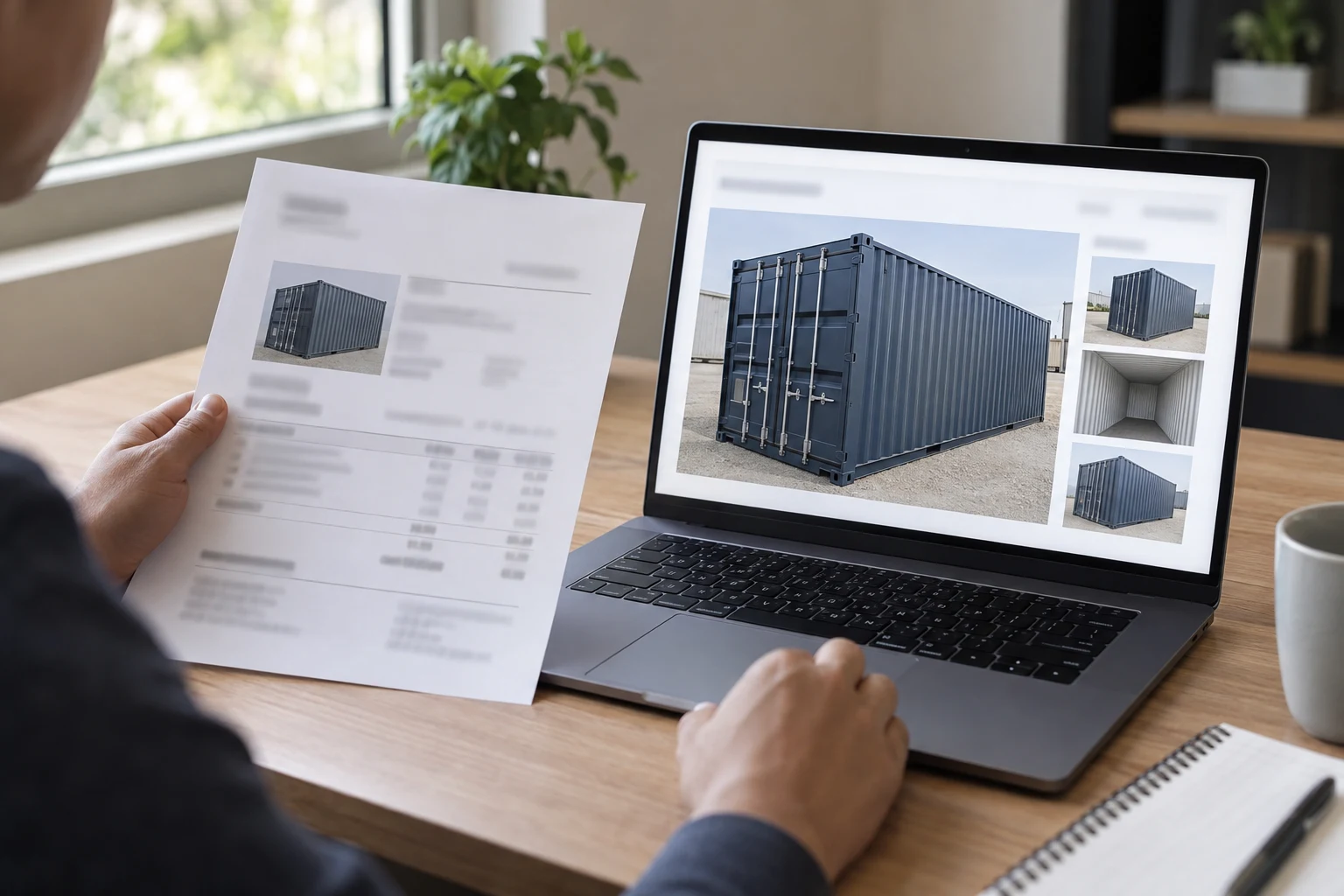
Before you pay: check the whole transaction
Work through these checks before a deposit or balance payment. A professional website, a container photo or a business registration cannot verify the whole sale.
Use reviews and complaint searches as extra checks. A low price, polished photos, HTTPS or a high star rating cannot, on its own, tell you whether this purchase is safe or fraudulent. Compare the full delivered price and written terms before judging the price.
- Identify the seller. Ask for the business name, invoice entity, address and the person handling the sale. Record who is responsible for the container and who is responsible for delivery.
- Contact the business independently. Find its contact details outside the advertisement, invoice or payment message. Confirm that the business issued this offer and that the person handling it is authorized. An impersonator can borrow a real company's name and documents.
- Check what you are buying. Is it the container in the photos, or will the seller choose one later from an agreed condition grade? If the unit is already chosen, ask for current photos of its number, doors, outside, inside and disclosed damage. Otherwise, get the selection date, grade, inspection arrangements and replacement terms in writing.
- Agree how you will check the condition. Can you or an independent inspector inspect before acceptance? What will be checked? Which defects and repairs will be recorded? What happens if the unit differs from the agreement? A container number or recent video helps match the records to the unit. It does not prove who owns it.
- Pin down delivery. Confirm the depot or dispatch arrangements through the independently verified seller. Put the destination, delivery window, unloading method, site access assumptions and all charges in the offer. Ask who pays for waiting, failed placement, a return trip or equipment changes.
- Ask what the deposit covers. Get the answers in writing: what does it reserve, when is the unit chosen and when is the balance due? What cancellation or refund terms apply if selection or delivery fails? Check who receives the money. A deposit or sample photos alone do not prove fraud, but unclear terms still need answers.
- Check who will receive the payment and how you will pay. The recipient should match the business on the invoice. If another business collects it, check that relationship independently and get it in writing. Check changed instructions outside the message thread. Ask your payment provider whether purchase protection covers this seller, container and payment method.
- Save the offer, terms, messages and payment instructions before they change. Stop if the seller's identity, payment recipient or delivery details do not match and nobody can explain why. Do not let pressure to pay prevent you from checking independently.
Treat changed payment instructions as a new check
A familiar email thread can be compromised. If an account, recipient or payment procedure changes, contact the seller using details you obtained independently and confirm the change before paying. Do not use a new phone number supplied in the same message to authenticate it.
Ask what protections apply before choosing a payment method. A marketplace listing or linked card does not automatically give every transaction buyer protection. Pressure to use a hard-to-reverse payment route while avoiding independent checks is a reason to pause.
Two situations to work through
The examples below show situations to check before paying; they do not identify any business.
| Situation | What to check | What the facts establish |
|---|---|---|
| A seller uses sample photos and allocates a unit after a deposit. | Ask what the deposit reserves, when the actual unit is selected, how you can inspect it, and what written remedy applies if it differs. | The photos do not verify the eventual unit. Later allocation or a deposit alone does not establish fraud. |
| A familiar invoice thread suddenly gives new bank details and says delivery depends on paying today. | Call the seller through the independently verified contact. If it denies the change, keep the message and stop the replacement payment. | The changed instruction conflicts with the independently verified seller. Preserve that fact without inventing who sent the message. |
Already paid? Contact the payment provider now
Start here if the container was not delivered as agreed, payment details appear false, or someone used your account. Preparing a website report does not contact your bank or stop a payment.
- Use a known channel now: the number on your card, your bank's genuine app, or the provider contact you independently verify. Explain the payment and what happened. Do not wait for a ContainerPick review or for the seller to promise another delivery date.
- Ask for the correct route: a purchase dispute, unauthorized-payment report, cancellation, or recall, as the facts require. Request a reference number, the applicable deadline and any required written notice or documents. Keep a copy and follow the provider's instructions promptly.
- Keep the original order and payment records. Write a short timeline with dates. If your account or login details were exposed, tell the provider immediately. Change exposed or reused passwords and enable multifactor authentication.
- Report suspected fraud through official channels found independently. Keep the report confirmation. Reporting supports the record of the incident; it does not replace a dispute, required notice or recall, and does not guarantee money back.
Say who made the payment and what went wrong
If you approved and made the container purchase but the seller failed to deliver, describe an authorized purchase with non-delivery. Do not call it an unauthorized charge just to seek a refund. Report any separate charges or transfers made without your authority as separate events.
If someone obtained account access or a verification code and initiated a transfer, tell the financial institution exactly what happened. Explain which actions you approved and which you did not. Ask how your account agreement treats the event and what immediate reporting or account-security steps apply.
A chargeback is a card-payment dispute process that may reverse a charge under applicable rules. It is not a guaranteed refund. A bank-wire recall is a different request, and payment methods do not share one universal deadline.
Use the steps for the actual payment method. If you are unsure, check your receipt and ask the provider to identify the transfer type.
Credit card
- Contact the issuer immediately. For a purchase you made that was not delivered as agreed, ask for the goods-not-received or billing-error route. For a charge made without your authority, report that fact separately.
- For a purchase you authorized but did not receive, ask the issuer whether a merchandise-not-received dispute applies. A quality complaint or an unauthorized charge is a different issue. The card agreement and applicable network process determine the evidence and steps; ask whether merchant contact is required.
- Ask the issuer for the correct dispute channel, evidence and deadline for your specific card and transaction. Report promptly and keep confirmation of receipt. An unauthorized-charge report follows its own process; do not assume a purchase dispute and unauthorized use share the same rules.
Confirm the dispute deadline for your card
Canadian card purchase disputes do not use one universal deadline on this page. Contact the issuer as soon as the delivery or payment problem appears. Ask when its deadline starts, whether a written form is required and which card-agreement or network process covers your transaction.
Use the secure channel or form the issuer confirms for the actual dispute. Include the payment details, promised delivery, dated events and relevant correspondence. Keep a copy and proof that the issuer received it; a report prepared elsewhere does not start the card dispute.
If delivery has been repeatedly delayed, contact the issuer now and provide the full timeline. Ask which options remain available. A revised delivery promise should not be treated as extending the issuer’s deadline without its written confirmation.
Keep purchase disputes, unauthorized use and business-account procedures separate. Ask the issuer which process applies to your account and payment, including any required notice and evidence. No outcome or refund is guaranteed.
Debit card
- Contact your bank or credit union immediately. If you made the purchase but did not receive the container, ask whether a merchandise-not-received purchase dispute is available and what evidence and deadline it requires.
- If someone else made a debit or transfer without authority, say so and explain any lost card, compromised account or fraud-obtained access. Ask about the applicable error-reporting process and any written confirmation required.
- A purchase you approved but did not receive is different from a debit or transfer you did not make or approve. Describe the facts accurately and ask the institution which purchase-dispute or unauthorized-transaction process applies to this account.
Bank wire
- Call the originating bank now and explain the suspected fraud. Ask whether it can attempt a recall or reversal and contact the receiving bank. Give the transaction reference, date, amount and beneficiary details through the bank's secure channel.
- Ask what documentation is needed and obtain a case reference. Let the bank handle bank-to-bank requests; do not send another payment to release or protect the first one.
- A recall may fail once funds have moved. A wire is not a card chargeback, and ordinary consumer electronic-transfer notice rules do not apply to every wire system. If the transfer type is unclear, have the bank identify it.
Bank transfer (including Interac e-Transfer) or pre-authorized debit
- For an Interac e-Transfer, contact your bank or credit union. Check whether the transfer can still be cancelled in online banking. Once deposited, the sender cannot cancel it; ask the institution to investigate suspected fraud.
- Contact the bank promptly. Explain whether you sent a bank transfer or permitted a seller to debit the account. Ask what cancellation, recall, return or dispute process is available for the exact transaction, and obtain its required channel and deadline.
- Report any debit or transfer you did not make or approve immediately, and keep it separate from non-delivery of an authorized purchase. Read your account agreement and ask the financial institution how to submit the transaction report and supporting evidence.
- An authorized purchase that was not delivered is not automatically an unauthorized transfer. Describe who initiated and approved the payment, then ask the bank which process covers the transaction. Do not borrow the card or wire procedure for a different payment method.
Payment app
- Use the genuine app or independently verified provider support immediately. Ask whether cancellation, reversal, a purchase dispute or eligible buyer protection is available.
- Explain whether this was a purchase payment or person-to-person transfer and how it was funded. Do not assume a friends-and-family transfer, wallet balance or linked card has the same protection as a protected purchase.
- If someone took over your account or initiated transfers without authority, report that to the app and the account-holding bank as relevant. Describe who initiated each payment, ask which institution handles the dispute, and keep each reference.
Cryptocurrency
- Contact the actual exchange or cryptocurrency ATM operator promptly to ask what action is possible. Completed cryptocurrency transfers are typically irreversible; provider contact does not mean the blockchain payment can be undone.
- Preserve the receiving address, coin or token, amount, transaction hash, date and time, and messages. Share these through independently verified provider or official reporting channels.
- If an account or wallet was compromised, tell the provider and secure the exposed access. Do not pay an unsolicited recovery agent who promises reimbursement or asks for credentials or another transfer.
Another method or unsure
Contact the company you used to pay immediately and ask which cancellation or dispute process applies. If you used a money-transfer company, contact that company directly through a verified channel.
If the card or account is for business use
Business-card purchase disputes depend on the actual account agreement and applicable network terms. Identify whether the account is personal or business and describe the transaction. Ask the issuer which dispute route, evidence and deadline apply instead of assuming consumer-card treatment.
Unauthorized transactions are a separate issue from a business purchase dispute. Report promptly, explain who initiated and approved the transaction, and ask the provider to apply the process for the actual business card or bank account. Keep any resulting complaint reference.
Keep the records and a clear account of what happened
Keep originals securely. Build a dated timeline that distinguishes what you observed from what you suspect; a delay alone is not proof of fraud.
Send sensitive transaction details only through a secure channel you have checked with the payment provider or official agency. Never publish account numbers, card details, identity documents or raw records. The website report tool below asks only which records you have. It does not upload them.
- The listing or offer, its website address, seller identity, invoice and contract.
- The agreed size, quantity, condition, unit number if supplied, or later allocation and inspection terms.
- The delivery destination, promised date or window, unloading agreement, and later delivery explanations.
- The payment receipt, transaction reference and payee details, plus any changed instructions.
- Original messages and emails, including full headers where available; saved web pages and relevant photos.
- Inspection, depot-release or delivery records you received, cancellation or refund requests, and bank or official report references.
Prepare a short message for your bank or provider
Use the template below to organize the facts, then edit it in your own document or the provider's secure channel. Choose the description that actually happened and remove unused placeholders. Add any required name or account identification only in that verified channel.
Ask the provider how to deliver the required notice. Copying this template or preparing a website report does not send a dispute, satisfy a deadline or start a recall.
Subject: Container payment problem — request for the appropriate dispute or recall

Payment date: [date]
Amount and currency: [amount]
Payment method and transaction reference: [method/reference]
Seller or payee shown in my records: [name]
What was agreed: [container, allocation terms and promised delivery]
What happened: [short dated facts and checks made]
Who initiated the payment: [I made and authorized this purchase / another person initiated it without my authority / I am unsure — explain the steps]

Please identify the correct dispute, error-reporting or recall process for these facts and my account. Can you take any urgent action now? Please give me a reference number, the required notice channel or address, the receipt deadline, and the records you need.

I hold: [offer/invoice/payment receipt/messages/delivery records]. I can provide relevant copies through your verified secure channel.
Secure exposed accounts and make an official report
If a login, verification code or account access was exposed, alert the provider immediately. Change compromised and reused passwords and enable multifactor authentication. Do not share a new code or transfer money because a caller says it will protect the account or reverse fraud.
For suspected fraud in Canada, contact local police and independently find the Canadian Anti-Fraud Centre’s official reporting service. Keep your confirmation and original records. Reporting the incident is separate from contacting the payment provider about a dispute or recall.
Keep the original invoice, payment record, messages and delivery timeline after reporting. Local police investigate; the Canadian Anti-Fraud Centre collects information to support law enforcement. An official report does not guarantee an investigation, payment recovery or a refund.
Be alert to a second scam. Someone who unexpectedly offers to recover your money in exchange for an upfront fee, credentials or another payment may be targeting you again. Verify an alleged agency through a contact you find independently. Government agencies do not guarantee recovery.
Check or report a website
Use the tools below to check a hostname or organize your account of events.
Check the reviewed website reports
Enter the exact website domain. A missing result does not mean a website is safe.
No reviewed reports are published yet.
Enter a domain or paste an HTTP or HTTPS website address.
We compare the exact hostname you confirm. Other subdomains are checked separately.
A reviewed report describes one case. It does not prove that every offer from that domain is fraudulent. A domain with no report is not necessarily safe.
Prepare your account of events →Prepare a website report
Prepare a factual draft to review, copy or download. Preparing it sends nothing. This tool does not submit or publish reports.
Your draft stays in this open page. You choose whether to copy or download it and share it with your payment provider or an official reporting service.
Review your draft
Prepare a draft to see your report here.
Nothing has been sent.
Copying or downloading does not contact your bank or an official agency. Contact your payment provider directly about a payment.
Common questions
How can I verify that a container supplier and its offer are legitimate?
Check the business independently and confirm that it issued the offer. Match the container or selection terms, condition records, payment recipient and delivery agreement. Registration details, a container number, photos or HTTPS are only part of the check. Stop if identity, payment or delivery details still conflict. This guide and the website report tool do not certify sellers.
Does a deposit mean a container offer is fraudulent?
No. Check what it reserves, when the unit is allocated, when the balance is due and what written cancellation or failure terms apply. Verify the seller and payment recipient independently.
Is a container number or a fresh video enough to verify a sale?
It can help match photos or reports to the container in an offer. It does not prove ownership, confirm who should receive payment or guarantee delivery.
Can I wait for the seller before contacting my bank?
Contact the payment provider promptly. Ask which purchase-dispute or unauthorized-transaction route applies, whether merchant contact is required, and what evidence and deadline it uses. Do not assume a new delivery promise extends that period.
Does no website report mean the seller is safe?
No. It means no reviewed report is published for the exact hostname checked. It does not verify the business, its offer or a related subdomain.
Will preparing a report recover my payment?
No. It prepares text for your own use and sends nothing. Contact the provider directly for a dispute or recall and follow its required notice process.