
Receiving and retrieval
Specify packaged dimensions, peak load and the items you need to reach. Confirm the door arrangement and airflow plan before relying on a pallet count.
Ask for written quotes. Compare the price and the work included for your project.
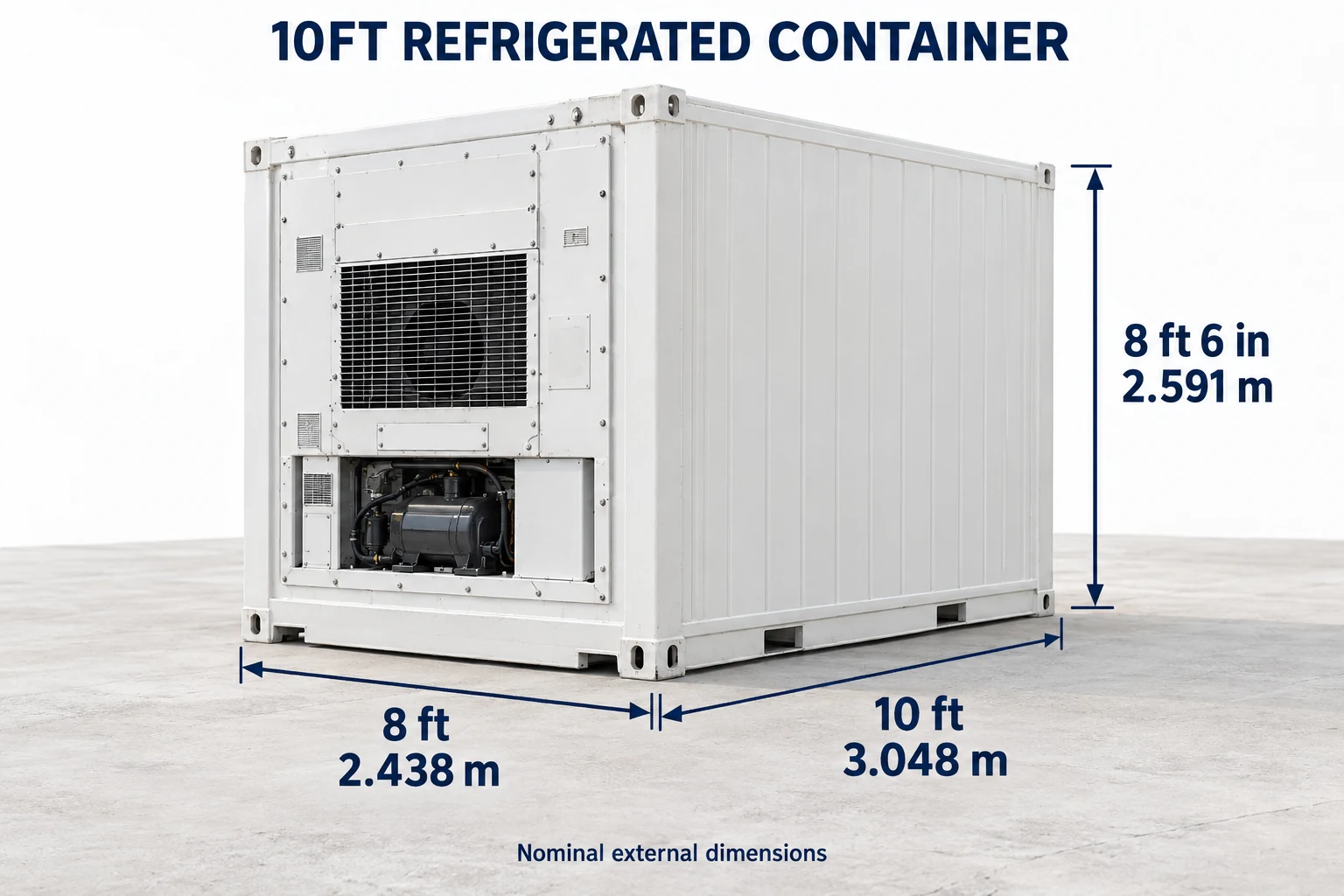
Compact refrigerated storage for smaller loads and sites. Compare this standard-height cargo-door example, then specify the cooling duty, site power and delivered scope.
Request a delivered quote
The supplier confirms the actual unit, working condition and delivery details.
The example below is a nominal 10ft × 8ft × 8ft 6in cargo-door container with an insulated interior and T-floor. Its machinery and insulation reduce the usable room.
Swipe the table to see every column.
| Measurement | Length | Width | Height |
|---|---|---|---|
| Exterior, imperial units | 10 ft | 8 ft | 8 ft 6 in |
| Exterior, metric | 3.048 m | 2.438 m | 2.591 m |
| Interior, metric | 2.438 m | 2.235 m | 2.235 m |
| Cargo-door opening | — | 2.234 m | 2.248 m |
Exterior, interior and cargo-door figures describe this one documented example. Door opening and interior height are separate measurements; confirm the actual unit, floor and load line.
Specify packaged dimensions, peak load and the items you need to reach. Confirm the door arrangement and airflow plan before relying on a pallet count.
Describe whether goods arrive already chilled or frozen, or need cooling from warm. Give the batch size, arrival temperature and required completion time.
The cargo-door example uses three-phase supply. Portable designs have their own cooling equipment and connection requirements.
Swipe the table to see every column.
| Separate documented example | Published temperature range | Published supply |
|---|---|---|
| 10ft standard-height cargo-door example | −10 to 70°F (−23.3 to 21.1°C) | 230 V / 60 A or 460 V / 30 A, three phase |
| Portable standard-outlet product | 0 to 50°F (−17.8 to 10°C) | 110 V / 15 A, advertised for a standard outlet |
These specifications belong to separate products. Check the offered machine’s voltage, phase, frequency, circuit and connector with your electrician. Connection amperage does not establish daily energy use or the time needed to cool a warm load.
Choose 10ft when a smaller packaged load fits the actual interior and you can provide the selected machine’s supply; compare a portable walk-in if frequent entry determines the door choice.
The standard-height example has a 2.438 × 2.235 × 2.235 m interior. Its 2.234 m-wide × 2.248 m-high opening is a separate measurement: passing the doorway does not establish usable storage height.
Use a loading plan for this cargo-door T-floor configuration. Portable door-specific pallet counts describe a different box and do not establish how items can be retrieved from the shorter cargo-door room.
The standard-height example’s 230 V / 60 A or 460 V / 30 A ratings are three phase. A portable standard-outlet model is a separate system; neither its supply nor its temperature range transfers to this cargo-door example.
Keep the delivered box, refrigeration machine and condition evidence together. A compact footprint does not establish the machine’s working condition or the included service arrangements.
Compare equipment scope by height, condition and refrigeration system. Request a current Canadian quote in CAD for the exact configuration, testing, delivery and site electrical work.
Swipe the table to see every column.
| Configuration and inclusions | Estimated price |
|---|---|
| 10ft used refrigerated storage container with working cooling, specialist or cut-down configuration; electrical work extra | from CA$10,000 · low-end estimate, before tax |
Your supplier confirms availability and the final quote for the assigned unit. Confirm delivery, unloading, taxes, any transformer or conversion and site electrical work separately.
Request the machine identity, a dated operating test at the required temperature and checks of alarms, defrost and door seals.
Compare insulation, floor, repairs and equipment age separately. A new motor can be fitted to a used box; request the warranty terms for each.
Have the quote separate equipment, any transformer or conversion, transport, unloading, taxes and site electrical work.
A smaller installed box can still arrive on a long delivery vehicle. Confirm the method for your address and leave room for doors, receiving and refrigeration service.
A separate portable product advertises 110 V / 15 A operation. The standard-height cargo-door example here uses three phase. Confirm the exact offered machine and connection; length does not determine the supply.
Four is a published figure for one portable high-cube model’s swing-door arrangement; its butcher-door arrangement lists three. The cargo-door dimensions above describe a different model. Check packaged sizes, load height, airflow and retrieval space for the proposed unit.
Compact size does not establish a lower equipment cost. When both 10ft and 20ft fit, compare the actual shell, refrigeration machinery, condition, test results and itemized Canadian delivered quotes.
Include the delivery postal code, packaged load, door routine, target temperature, arrival temperature, site voltage and phase, condition preference and unloading details. Ask for a dated refrigeration test and the complete delivered scope.
Compare the cooling needs and delivery work together.