
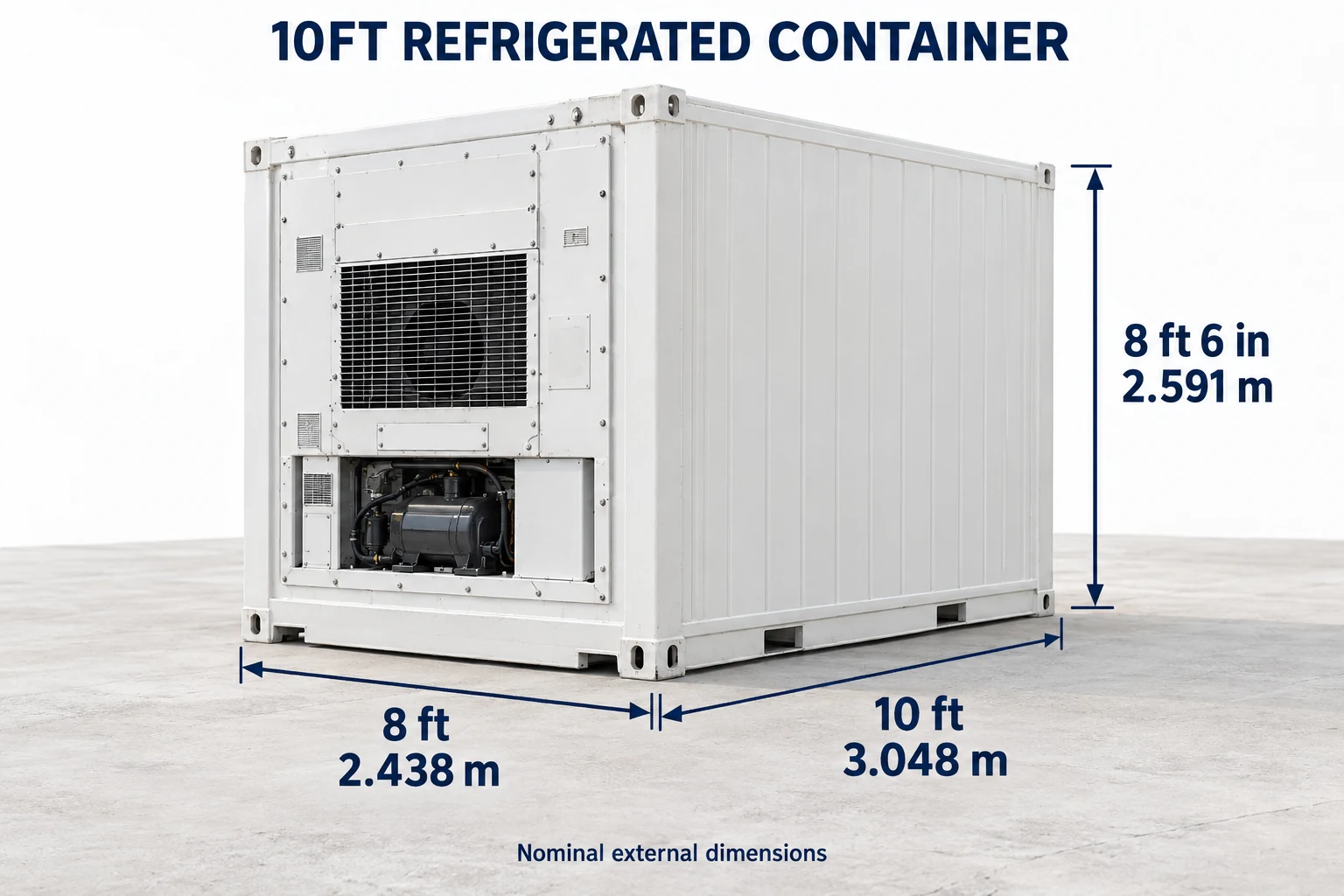
10ft
A small on-site inventory or a constrained placement area.
Door configuration can change pallet positions. Small size alone does not establish household-outlet compatibility.
View 10ft details →Ask for written quotes. Compare the price and the work included for your project.
Compare refrigerated containers by usable space, temperature duty, site power and complete purchase scope. Explore the 10ft, 20ft and 40ft model examples, then prepare a request for your load and Canadian postal code. Specifications describe separate documented configurations; request current Canadian pricing and unit evidence.
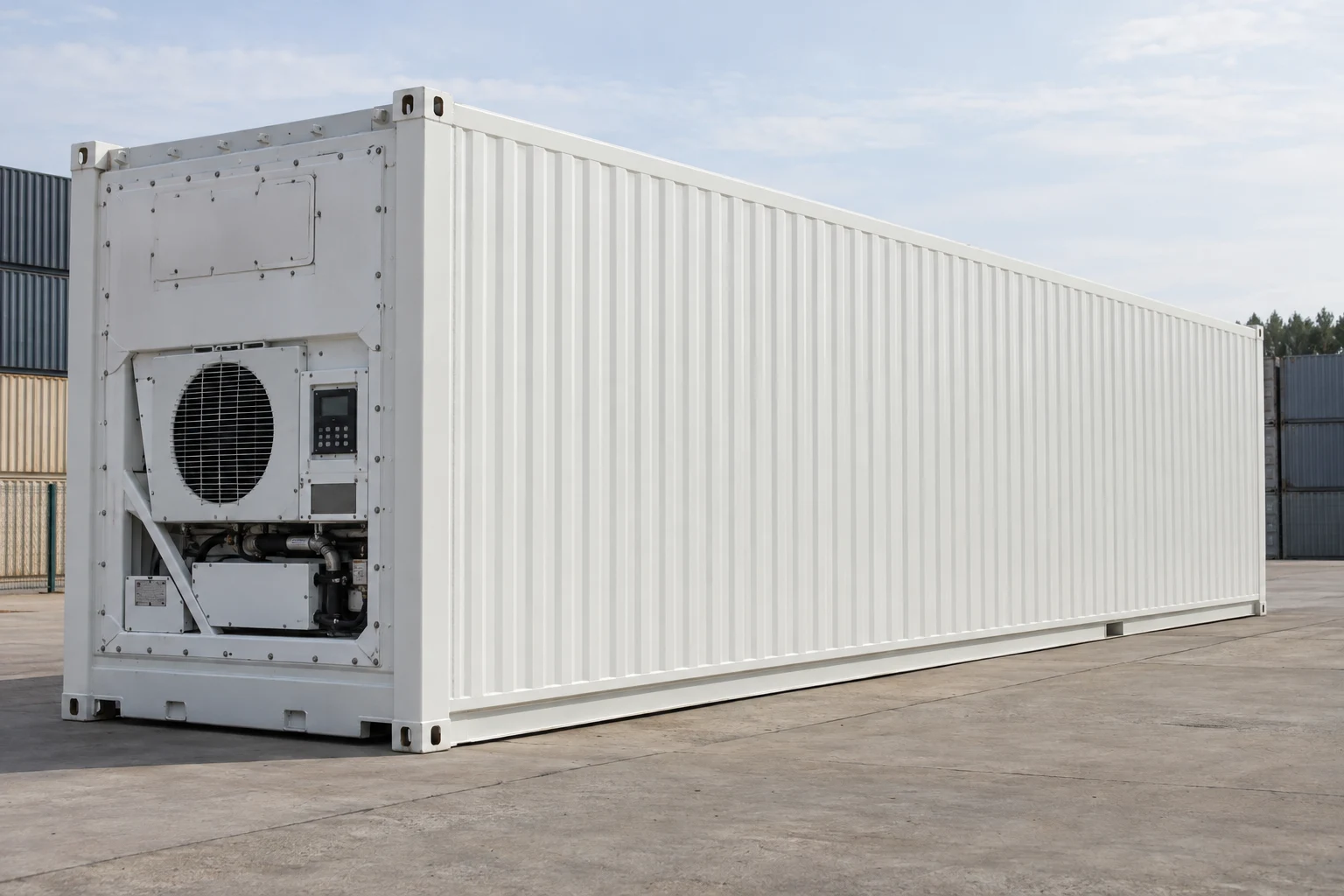
A small on-site inventory or a constrained placement area.
Door configuration can change pallet positions. Small size alone does not establish household-outlet compatibility.
View 10ft details →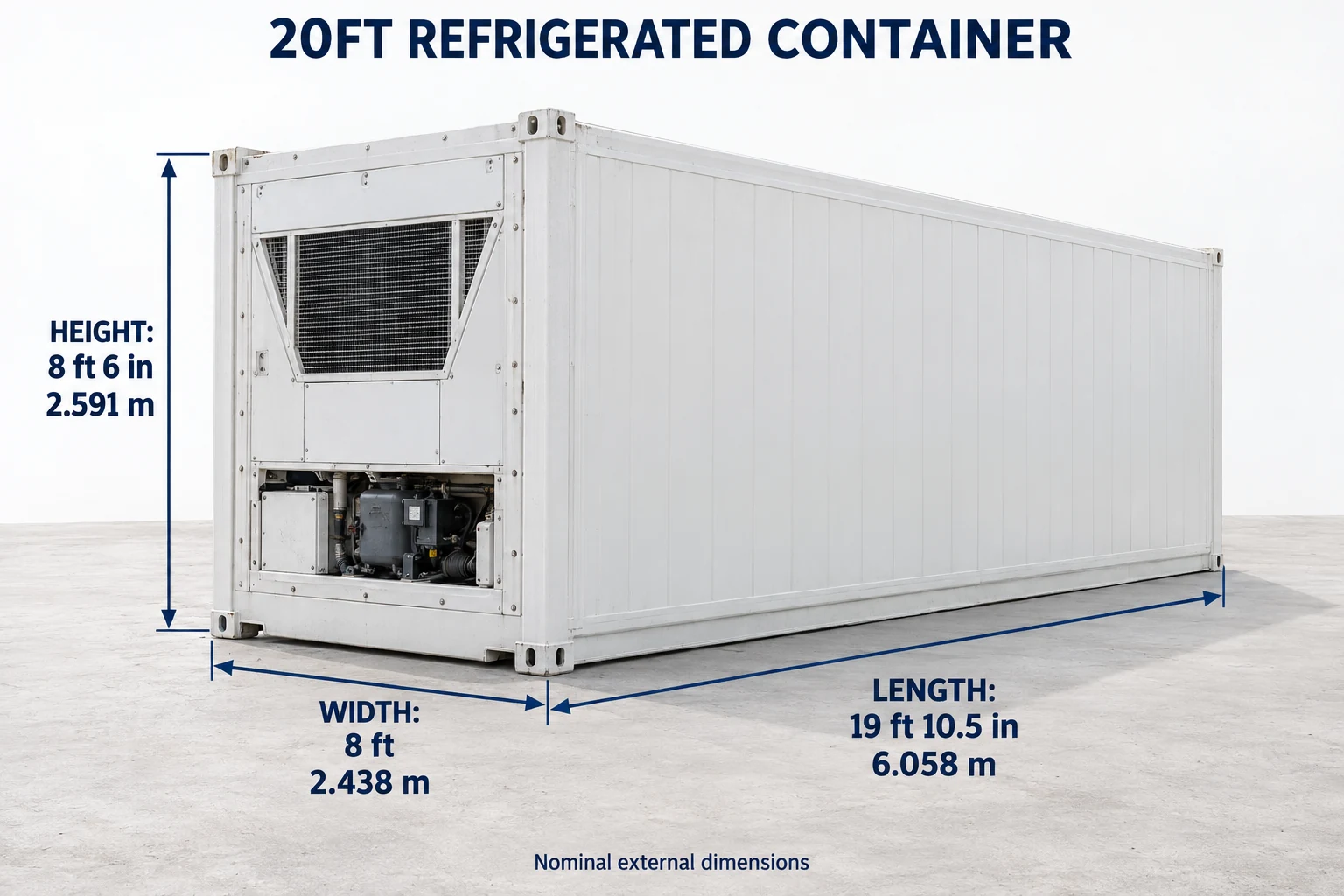
A moderate pallet inventory with regular receiving.
Reserve retrieval and loading access before treating every advertised position as usable storage.
View 20ft details →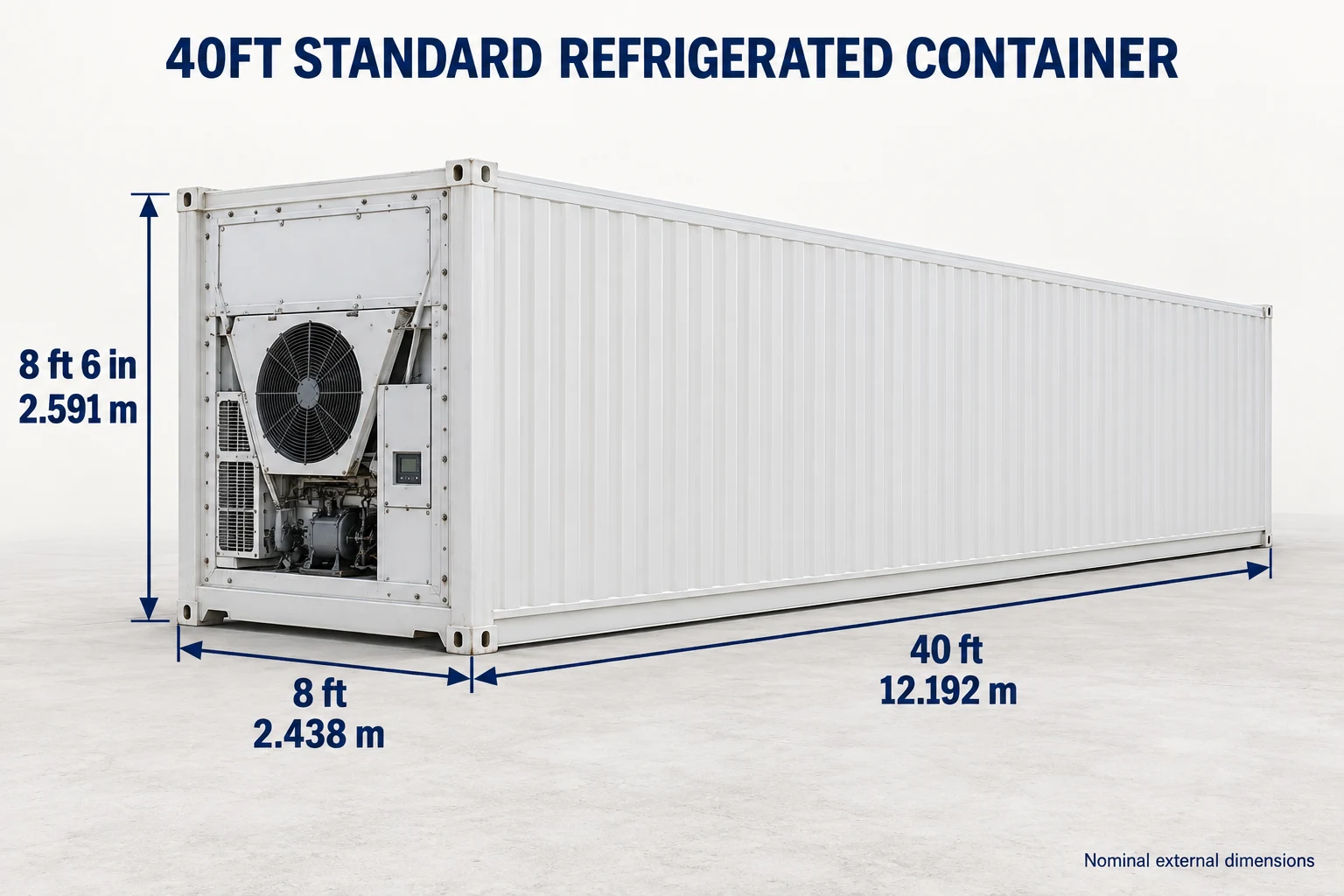
A larger batch held at temperature.
More floor length requires a loading and retrieval plan. Compare standard height with high cube; energy use does not follow a fixed 2× rule.
View 40ft details →Holding already chilled or frozen goods is a different duty from cooling warm arrivals or freezing a batch. State the incoming temperature, quantity and completion time when that work is required. An insulated shell without working refrigeration provides no active temperature control.
For 48 × 40 in pallets, one portable-storage fleet publishes the positions below. Door layout, packaged goods and airflow requirements determine how many positions you can actually use. These examples are separate from the marine units and the 10ft outlet model compared further down.
| Portable example | Published inside floor, L × W | Documented pallet positions | Configuration limit |
|---|---|---|---|
| Portable 10ft example | 7 ft 8 in × 7 ft 4 in (2.337 × 2.235 m) | 3 with a butcher door; 4 with 3/2/1 swing doors | The 10ft sheet limits front-row pallet height to 60.6 in. |
| Portable 20ft example · three phase | 17 ft 9 in × 7 ft 4 in (5.410 × 2.235 m) | 9 | Inside height 8 ft 4 in; the permitted cargo height still follows the unit loading instructions. |
| Portable 40ft example | 38 ft × 7 ft 4 in (11.582 × 2.235 m) | 20 | The published count does not identify one height variant; no interior height is assumed here. |
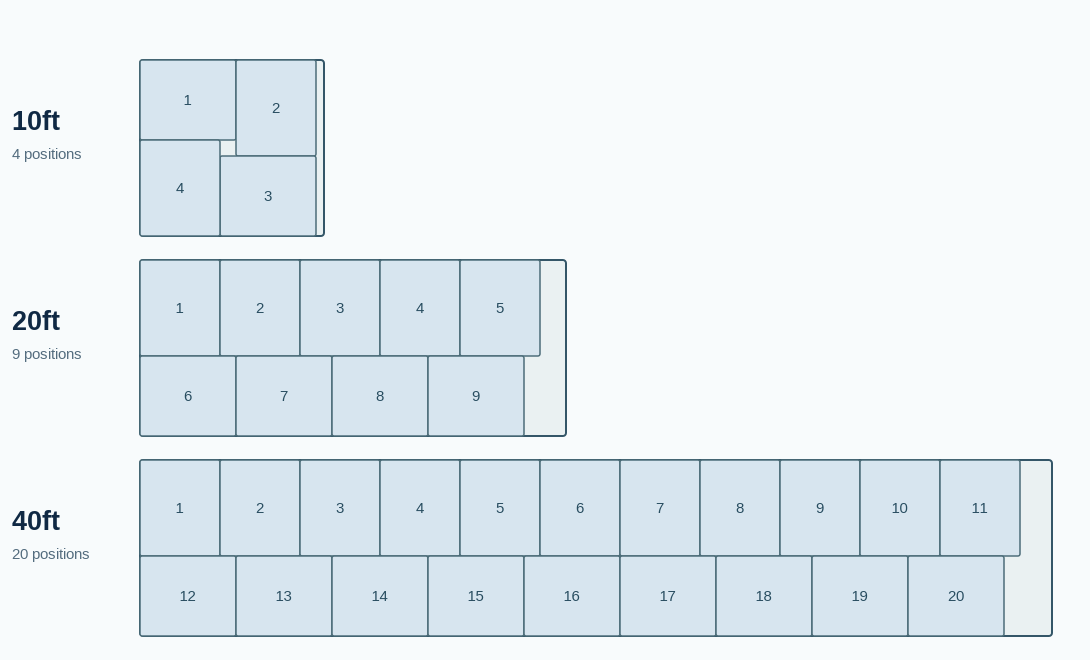
One floor layer of nominal pallet footprints, shown at the same scale. The 10ft plan illustrates the four-position door option; another door option is rated for three. These drawings reserve no cargo or handling clearance and are not approved food-loading plans. Keep merchandise within the unit airflow and loading limits.
For this fleet, the handling guide specifies 2 in between merchandise and sidewalls, 12 in below the ceiling and 6–12 in between merchandise and rear doors. The plans show nominal pallet footprints; they do not establish those merchandise clearances. Packaged loads, handling equipment and any retrieval aisle can reduce usable positions.
For an explicit planning scenario, assume packaged goods fill each 48 × 40 in footprint, reserve 2 in at both sidewalls and choose 12 in at the rear doors. The clearance illustrations demonstrate 2 positions in the portable 10ft example, 8 in the portable 20ft example and 18 in the portable 40ft example. These are illustrative placements before any retrieval aisle, front machinery or handling clearance; they are not validated storage capacities.
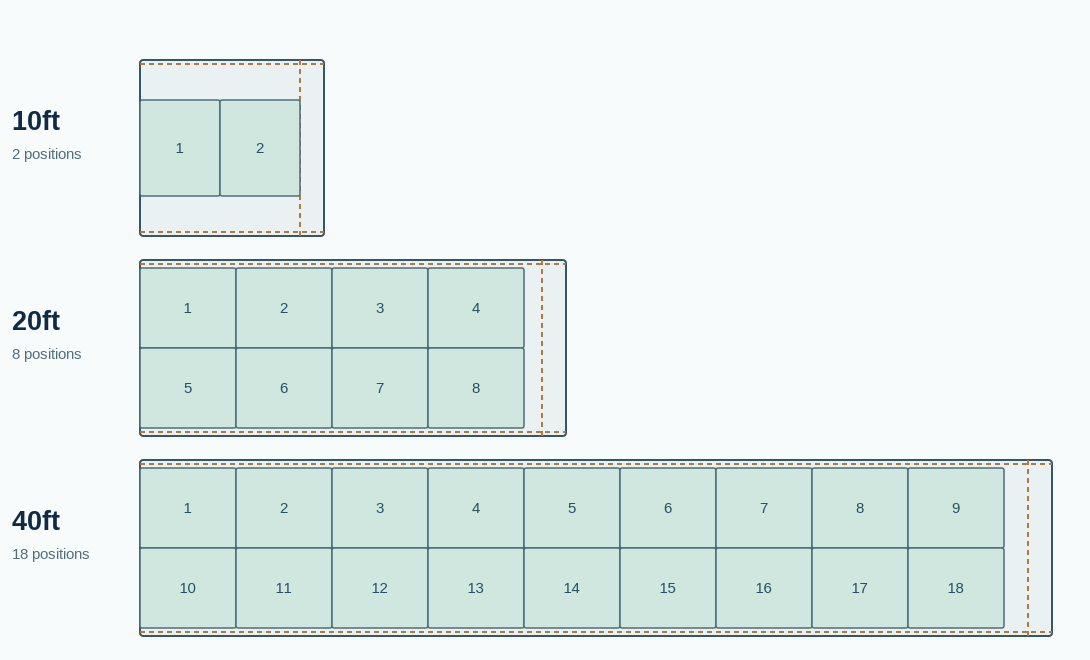
Illustrative planning scenario, not validated storage capacity: packaged goods fill each pallet footprint, with 2 in reserved at the sidewalls and 12 in at the rear doors on the right. Height limits, machinery airflow, handling space and retrieval access still need to be checked.
Marine bottom-airflow reefers have separate T-bar floor and load-line rules. Interior height is not the permitted loading height. Pallet positions do not establish payload or stacking limits, or suitability for a particular food.
Prices vary with condition, specification, availability and delivery location. Request a quote for your project. Confirm the refrigeration equipment and working condition. Power setup, transport, unloading, placement and repairs are separate.
| Configuration and inclusions | Price |
|---|---|
| 10ft used refrigerated storage container with working cooling, specialist or cut-down configuration; electrical work extra | from CA$10,000 · low-end estimate, before tax |
| 20ft used refrigerated container with working refrigeration; power connection and commissioning excluded | CA$8,950 · tax not stated · checked 16 Oct 2026 |
| 40ft used refrigerated container with working refrigeration; power connection and commissioning excluded | CA$9,850–CA$11,950 · tax not stated · checked 16 Oct 2026 |
Compare the same height, condition, machinery identity, equipment age and included features. A standard-height 20ft and a 40ft High Cube have different specifications; differences between complete offers cannot be attributed to length alone. Quote the 10ft configuration separately.
Some marine refrigeration machinery requires 460 V three-phase supply, with a suitable transformer where specified. The exact voltage, phase, frequency, connector and circuit must match the assigned equipment and the site. Have the electrician confirm the equipment acceptance and installation requirements for the Canadian jurisdiction; a specification from another market does not establish approval. Itemize transformers, freight, unloading, taxes and electrical work separately; do not transfer one model’s power or pallet claims to another.
The marine examples below cannot run from an ordinary 120 V household outlet. A specific portable 10ft product does advertise 110 V/15 A standard-outlet operation. Other 10ft configurations require higher voltage or three phase.
| Configuration example | Published temperature range | Published connection | Normal household outlet? |
|---|---|---|---|
| Separate portable 10ft outlet model | 0 to 50°F (−17.8 to 10°C) | 110 V/15 A advertised; phase, frequency and connector not specified | Advertised as compatible for this product only. |
| Marine 20ft example | −10 to 70°F (−23.3 to 21.1°C) | 460 V/30 A or 230 V/60 A, three phase; 50/60 Hz listed as an option | No. |
| Marine 40ft standard example | −20 to 70°F (−28.9 to 21.1°C) | Most machinery listed at 208/230 or 380/460 V, three phase, 50/60 Hz | No; identify the installed machinery. |
| Marine 40ft high cube example | −10 to 70°F (−23.3 to 21.1°C) | 460 V/30 A or 230 V/60 A, three phase; frequency not confirmed here | No. |
A selectable temperature or product-sheet range is not a measured product temperature, a pull-down time or a food-storage recommendation. The four products above do not provide a verified ambient operating limit in this comparison.
The listed amperages are connection ratings, rather than measured running, starting or maximum current. A plug adapter cannot create the required voltage or phase. Match the assigned unit voltage, phase, 60 Hz compatibility, connector and circuit requirements with its OEM instructions and your electrician before delivery.
Electricity use depends on the refrigeration system, temperature setting, weather, load and door openings. There is no verified size-only ratio here: a matched daily-energy test for the 10ft, 20ft and 40ft examples was not available.
| Documented electrical operating point | What the number means |
|---|---|
| 11.03 kW electrical input | One OEM platform at full cooling, return air 1.7°C (about 35°F), ambient 38°C (about 100°F), 460/230 V three phase, 60 Hz; 2019 manual. |
| 11.99 kW cooling capacity at that point | Heat-removal output, not electrical consumption. This is not a 20ft-versus 40ft test. |
Worked energy-cost example: 11.03 kW sustained for one hour uses 11.03 kWh. At an example rate of CAD $0.15/kWh, that costs CAD $1.65. For your budget, use metered energy over the intended operating period and your own utility tariff.
For an operating budget, use accumulated meter kWh over representative holding periods, then multiply by the applicable energy rate. Record warm-load cooling separately. Weather, insulation, doors, defrost, ventilation and humidity control affect the result. Demand charges, fixed fees, taxes, maintenance and generator fuel are outside this energy-only calculation.
These manufacturer examples are different products from the portable fleet above. Dimensions are nominal; the pallet counts above do not transfer to them.
| Marine product example | Inside L × W × H, approximate feet | Inside L × W × H, metres | Door W × H, metres |
|---|---|---|---|
| Marine 20ft example | 17.46 × 7.33 × 7.38 ft | 5.321 × 2.235 × 2.248 m | 2.235 × 2.248 m |
| Marine 40ft standard example | 38.06 × 7.47 × 7.30 ft | 11.602 × 2.276 × 2.226 m | 2.276 × 2.299 m |
| Marine 40ft high cube example | 38.06 × 7.47 × 8.30 ft | 11.602 × 2.276 × 2.531 m | 2.276 × 2.603 m |
The high-cube example adds interior height, while its floor length and width match this standard-height example. Use the proposed unit floor, doorway and load line for a packaged-load plan; dry-container dimensions are not a reefer specification.
A non-operating reefer or NOR shell is not a working refrigerated purchase. For a used working unit, match condition photos, the machinery identity and the dated test report to the offered container. A PTI can include cooling and heating checks; review the procedure, results, skipped checks and repairs. A display photo shows one reading, rather than the temperature history or the performance of your load.
Have the quote itemize the shell and refrigeration, testing or repairs, delivery and placement, electrical equipment and setup, and taxes. Separate shell warranty from refrigeration warranty. Give the delivery operator the postal code, approach and placement photos, unloading access and door orientation; retain access to the machinery for service. Moving an empty reefer is a different arrangement from carrying cold goods under power.
Before taking over the installed container, agree on the operating conditions, records and named contacts below. Confirm which recording and notification functions are included in the delivered configuration.
| Handover item | Evidence to keep | Person to name |
|---|---|---|
| Unit identity and handover file | Container and refrigeration identifiers; document list and unresolved items. | Person handing over the equipment; person accepting the file. |
| Operating conditions and site checks | Agreed duty, load, ambient and door-use assumptions; completed check record and outstanding conditions. | Person completing the checks; person accepting the operating conditions. |
| Sensors and stored history | Recorded sensor or channel and its location; logging settings, retention period, and whether and how records can be exported. | Person checking readings and keeping the records. |
| Remote notification, if supplied | Installed alert capability, connectivity and power-loss behaviour; named recipient and confirmation that the agreed notification reaches them. | Person verifying notification delivery; alert recipient. |
| Response to an alarm or failure | Named response owner, contact route and agreed action; note any service arrangements still unresolved. | Operating contact; person responsible for intervention. |
| Loss of refrigeration or site power | Agreed contingency for the stored goods, including any alternative storage or power arrangement; record unresolved arrangements. | Person authorized to activate the contingency. |
A displayed reading or stored history does not establish that an alert has reached someone who will act on it. A recorder battery does not establish refrigeration backup power.
Choose a format and chilled or frozen holding duty below to keep both in the editable request notes.
Add your load, required temperature, site power and delivery details. Review the format and intended-use selections before sharing the draft. The request builder prepares a draft you can edit, copy or download. Sending through the quote form requires your consent and a separate send action.