
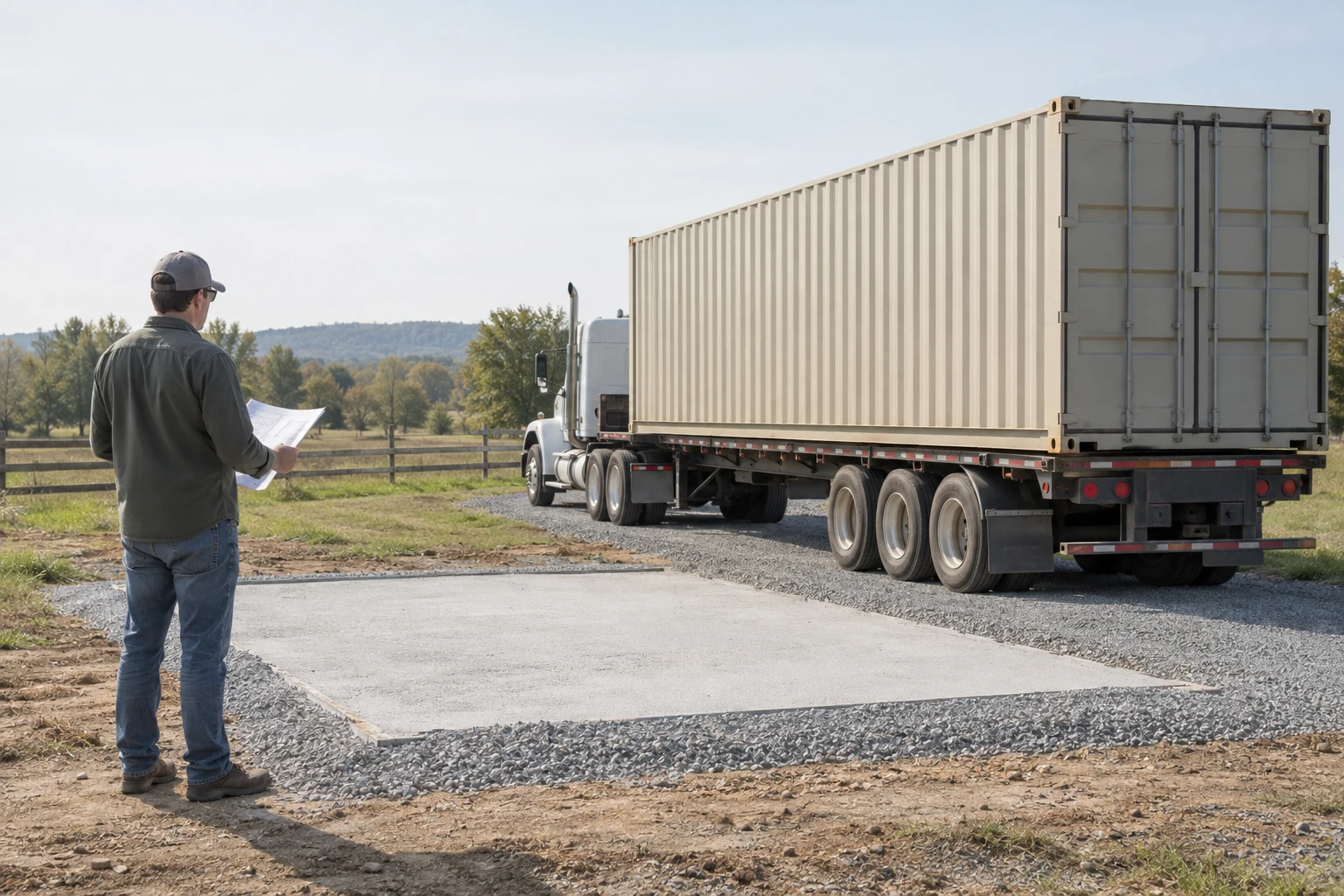
Agree who handles each part of the delivery
Ask whether transport, unloading and placement are covered by one agreement or separate providers. Keep the responsible companies and their contact details with the order so an unresolved step does not become your responsibility by assumption.
| Part of the order | Confirm with the seller |
|---|---|
| Container selection | Which unit or selection terms are included, and who confirms its condition before dispatch. |
| Transport | Who books the operator, gives pickup instructions and provides the delivery contact. |
| Unloading and placement | Which equipment is included, who supplies any separate lift and which final position is agreed. |
| Site preparation | Which checks and preparation the operator requires before accepting the job. |
| Handover | Who meets the driver, records the delivered unit and handles a condition or placement concern. |
Give the operator the order and site information
Provide the size, quantity, delivery address, intended position and door direction. Tell the operator whether the unit will be empty. If the proposed load or container changes, request a new assessment rather than relying on the original plan.
Send entrance, approach and placement photos with a sketch showing turns, slopes and overhead obstacles. Ask which measurements they need and whether the information is enough to approve access. The site-preparation guide covers the ground and placement checks in more detail.
Confirm how the container leaves the lorry
Equipment and manoeuvring space depend on the actual vehicle and job. Use the operator's requirements rather than a clearance number copied from a different delivery. A container fitting within a yard does not establish that the unloading operation fits there.
| Proposed method | Question to resolve |
|---|---|
| Lorry-mounted crane / HIAB | Can the actual crane lift the unit at the required radius, with assessed ground, safe outrigger setup and access? Confirm final placement and the included lift scope. |
| Tilt-bed or travelling axle trailer | Can this vehicle unload and place the unit at the agreed spot, with the available approach and ground conditions? |
| Flatbed or container chassis | Who supplies and operates suitable unloading equipment, and is it included in the written price? |
| Separate crane or lift | Who assesses the setup area, coordinates the lift and confirms its cost and responsibilities? |
A lorry-mounted crane, often described as HIAB delivery, combines transport and a lift within the crane’s confirmed capacity and reach. The operator needs the actual unit weight, lifting radius, outrigger setup and a ground assessment; a vehicle reaching the address does not confirm it can lift to the chosen position.
For work-related lifting, agree competent planning, appropriate supervision and safe execution. In Great Britain, HSE’s LOLER guidance explains the lifting-equipment duties; Northern Ireland has its own work-equipment and LOLER (NI) 1999 guidance. Check which rules and responsibilities apply to the operation.
Distinguish crane hire from an expressly agreed contract lift. Hiring a crane does not itself transfer lift-planning and execution responsibilities to the hire company. Have the responsible parties put the arrangement in writing; HSE explains the hire and contract-lift distinction.
Confirm the appointment and what happens if plans change
A preferred date in your request is a starting point for discussion. Keep the operator's confirmation and report any change to the agreed site conditions before dispatch. For price comparison, check the full acquisition total as well as the delivery line items.
- Get the confirmed delivery window and the contact who can update it.
- Ask what happens if weather or ground conditions change, the gate is locked or the agreed route is blocked.
- Clarify waiting, rescheduling, extra handling and failed-attempt charges before booking.
- Ask how changes to the address, placement or unloading equipment affect the order.
Use the agreed handover procedure
Have the site contact available and keep the approved route clear. Follow the operator's instructions about the unloading area and where people should wait. Once the operator says it is safe to approach, compare the delivered container number, condition and door direction with the order.
Photograph the unit and record any concerns. Follow the seller's written inspection and reporting process. Agree the handover steps before delivery so you know whom to contact and which records to keep.
Buying questions
Is unloading always included in shipping container delivery?
Ask for it to be explicit. Confirm transport, unloading equipment and placement at the agreed spot, including any separately supplied lift.
How much room does the delivery lorry need?
Obtain the requirements for the actual vehicle, container, route and unloading method. The container footprint alone does not describe the operation's space needs.
Can I use this page to arrange transport for a container I already own?
This page describes delivery with a purchase. For a separate move, ask a transport provider to confirm the unit, load, pickup arrangements and unloading at both ends before quoting.
Does preparing a request book delivery?
No. You can review and send a quote request with your consent, or copy or download it. The provider must separately confirm the operator, price and delivery appointment.