
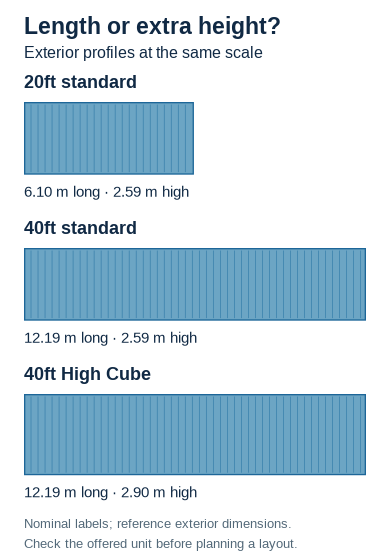
The differences that change your choice
Interior measurements are rounded examples for bare dry containers with cargo doors at one end; actual dimensions vary. The 20ft name is nominal: the exterior reference is about ≈6.06 m (19 ft 10½ in) long. The footprint is not usable floor area and excludes space for open doors, access, and delivery operations.
| What changes | 20ft standard | 40ft standard | 40ft High Cube |
|---|---|---|---|
| Nominal exterior footprint | ≈6.10 × 2.44 m (20 ft × 8 ft) | ≈12.19 × 2.44 m (40 ft × 8 ft) | ≈12.19 × 2.44 m (40 ft × 8 ft) |
| Nominal exterior height | ≈2.59 m (8 ft 6 in) | ≈2.59 m (8 ft 6 in) | ≈2.90 m (9 ft 6 in) |
| Example interior length | About 5.89 m (19 ft 4 in) | About 12.04 m (39 ft 6 in) | About 12.04 m (39 ft 6 in) |
| Example bare interior height | About 2.39 m (7 ft 10 in) | About 2.39 m (7 ft 10 in) | About 2.69 m (8 ft 10 in) |
| Main reason to choose it | A storage layout that fits a shorter site position | Long items or a longer storage layout | A longer layout that also needs vertical room |
Record the job before choosing the size
Choose a format for the items and access you need, then compare the complete cost of the layouts that work.
| Your requirement | Record for the comparison | Why it changes the decision |
|---|---|---|
| Longest or largest items | Dimensions including packaging, attachments and any space needed to handle them. | A continuous room may be necessary; two separate containers cannot provide one uninterrupted interior. |
| Retrieval routine | What you need daily, occasionally or only when the whole container is emptied. | An accessible layout can be more useful than a larger but blocked storage area. |
| Interior layout | Item positions, shelving depth and the path you will keep clear. | Nominal floor area does not show whether that layout works. |
| Height needed | Item and fit-out height, with the clearances relevant to your use. | High Cube is worth comparing when the extra height solves a specific limitation. |
| Door arrangement | Which end or opening you need to load and retrieve items. | Size alone does not establish the access arrangement. |
| Placement and delivery | Each intended position, door direction, approach and unloading plan. | An available footprint does not confirm a feasible delivery. |
| Actual unit and offer | Dimensions, condition evidence, quoted scope and open questions for each option. | Choose using the unit and service offered rather than a generic format name. |
When 20ft is enough—and when 40ft earns the space
Start with the items you will keep, including their packaging, and the space needed to retrieve them. A set of tools, parts bins, and seasonal equipment may work in a 20ft if each group fits without blocking the items you need regularly. Extra room at the far end of a 40ft adds little if this shorter layout already works.
A 40ft becomes useful when the floor plan needs more length: long materials that must stay in one piece, more rows of inventory, or equipment that cannot share the same floor position. Compare the longest item with the clear interior length, then allow for how it will be loaded and removed.
Choose High Cube when the height solves a problem
At 40ft, High Cube adds a foot of nominal exterior height while keeping the same nominal length and width. Consider it for tall equipment stored upright or a shelving layout that can use the extra vertical room. Check the actual doorway as well as the interior height, and account for any ceiling, floor, or other fit-out that will reduce clearance.
The taller roof will not create more floor positions for items that cannot be stacked, or widen an aisle between shelves. It also does not establish a higher payload or a safe shelving load. If height is sufficient in a standard 40ft, compare both delivered offers without assuming High Cube has a fixed price premium.
If a 20ft floor plan works and only the height is insufficient, a 20ft High Cube is worth comparing before committing to the longer footprint.
Test the item you need next
Think about taking a frequently used item out of a full container. Would you have to move a machine, clear boxes from the aisle or empty a shelf first? Draw where each item will go and how you will reach it. Extra space is useful only if it makes that job easier.
For occasional bulk storage, a deeper arrangement may be workable. For daily parts picking, shelf depth and a clear path matter more than packing every gap. A 40ft gives you more length to arrange storage; High Cube gives you more height, which may require a different retrieval method.
Two 20ft units can be worth considering for separate teams or stocks that need independent entrances. Compare both placements and their complete delivery scope; do not treat them as interchangeable with one long room.
One 40ft container or two 20ft containers?
Compare one continuous room with two separate rooms. Similar nominal total length does not make their access, placements or delivered cost interchangeable.
For example, two teams that need separate inventories may prefer two entrances. One long item may make a continuous 40ft room necessary instead. These are layout examples, not claims that either configuration is cheaper or feasible on your site.
| Decision | One 40ft | Two 20ft units |
|---|---|---|
| Continuous storage length | One longer interior for a layout or item that needs it. | Two separate interiors; their clear lengths cannot be added for one long item. |
| Independent access | Plan retrieval within the selected door arrangement. | Separate entrances can keep teams, stock or uses apart. |
| Positions on the site | Confirm one longer placement and its door direction. | Confirm both placements, the space between them and access to each door. |
| Delivery and unloading | Obtain the operator’s plan and complete price for this unit and position. | Obtain the plan for both units, including the actual trips and both placements; do not assume one trip or two. |
| Condition and price | Compare one acceptable unit and its full delivered scope. | Identify the condition and cost of each unit, plus the combined service scope. |
| Selection test | Does the continuous room make your storage routine work? | Do separate entrances solve a requirement worth the complete extra scope, if any? |
Check the delivery route as well as the final footprint
Mark the proposed container position and door end, then check the approach with the delivery operator. A spot long enough for a 40ft container does not establish that the truck can turn, line up, and unload there. The same check applies to a 20ft on a restricted site.
For High Cube, include overhead obstructions along the route and at the unloading position. Its standing height is not the height of the loaded vehicle or the space needed during unloading. Have the operator confirm the vehicle, unloading method, working space, ground requirements, and final door orientation before choosing a format.
Compare the total for the layout you will use
A 20ft container is not necessarily the cheaper delivered solution. Compare current offers for layouts that meet the same use; the unit condition, door configuration, actual trips, unloading and site work can change the total. Half the nominal length does not establish half the purchase or delivery cost.
Compare current offers for the same delivery address, stated condition, and door arrangement. Identify the container price, transport, unloading and placement, VAT, and any site work separately. An unpriced item is still unresolved; it is not a zero-cost inclusion.
Compare everything included in each quote for a layout that works for you. Length or extra height alone does not tell you the transport price.
Add the formats you are considering, stored-item dimensions, access routine, delivery postcode and site details. Review the request, then choose whether to send it with your consent, or copy or download it. The supplier confirms stock, price and delivery.
Buying questions
Is a 20ft container always cheaper than a 40ft container delivered?
No fixed price relationship follows from nominal length. Compare acceptable units at the same address with condition, door layout, actual trips, unloading, VAT and site work identified. An unknown required charge makes the comparison incomplete.
Do two 20ft containers provide the same usable layout as one 40ft?
No. Two 20ft units have separate rooms and entrances; their interior lengths do not form one continuous space. Compare your retrieval routine, both placements, the actual delivery plan and the full cost of each configuration.