
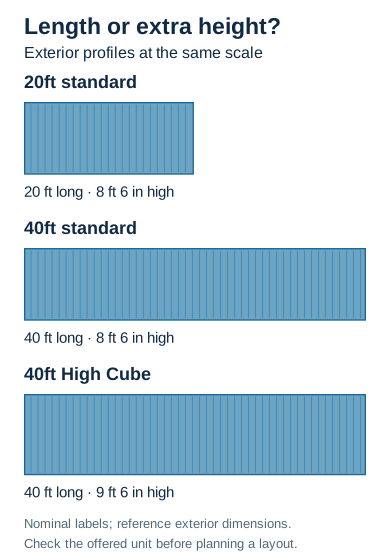
The differences that change your choice
Interior measurements are rounded examples for bare dry containers with cargo doors at one end; actual dimensions vary. The 20ft name is nominal: the exterior reference is about 19 ft 10½ in long. The footprint is not usable floor area and excludes space for open doors, access, and delivery operations.
| What changes | 20ft standard | 40ft standard | 40ft High Cube |
|---|---|---|---|
| Nominal exterior footprint | 20 ft × 8 ft | 40 ft × 8 ft | 40 ft × 8 ft |
| Nominal exterior height | 8 ft 6 in | 8 ft 6 in | 9 ft 6 in |
| Example interior length | About 19 ft 4 in | About 39 ft 6 in | About 39 ft 6 in |
| Example bare interior height | About 7 ft 10 in | About 7 ft 10 in | About 8 ft 10 in |
| Main reason to choose it | A storage layout that fits a shorter site position | Long items or a longer storage layout | A longer layout that also needs vertical room |
When 20ft is enough—and when 40ft earns the space
Start with the items you will keep, including their packaging, and the space needed to retrieve them. A set of tools, parts bins, and seasonal equipment may work in a 20ft if each group fits without blocking the items you need regularly. Extra room at the far end of a 40ft adds little if this shorter layout already works.
A 40ft becomes useful when the floor plan needs more length: long materials that must stay in one piece, more rows of inventory, or equipment that cannot share the same floor position. Compare the longest item with the clear interior length, then allow for how it will be loaded and removed.
Choose High Cube when the height solves a problem
At 40ft, High Cube adds a foot of nominal exterior height while keeping the same nominal length and width. Consider it for tall equipment stored upright or a shelving layout that can use the extra vertical room. Check the actual doorway as well as the interior height, and account for any ceiling, floor, or other fit-out that will reduce clearance.
The taller roof will not create more floor positions for items that cannot be stacked, or widen an aisle between shelves. It also does not establish a higher payload or a safe shelving load. If height is sufficient in a standard 40ft, compare both delivered offers without assuming High Cube has a fixed price premium.
If a 20ft floor plan works and only the height is insufficient, a 20ft High Cube is worth comparing before committing to the longer footprint.
Test the item you need next
Picture removing a frequently used item from a full container. Would you need to move another machine, clear boxes from the aisle, or empty a shelf first? Mark the storage positions and retrieval path together. The larger format is useful only if its extra space can serve that routine.
For occasional bulk storage, a deeper arrangement may be workable. For daily parts picking, shelf depth and a clear path matter more than packing every gap. A 40ft gives you more length to arrange storage; High Cube gives you more height, which may require a different retrieval method.
Two 20ft units can be worth considering for separate teams or stocks that need independent entrances. Compare both placements and their complete delivery scope; do not treat them as interchangeable with one long room.
Check the delivery route as well as the final footprint
Mark the proposed container position and door end, then check the approach with the delivery operator. A spot long enough for a 40ft container does not establish that the truck can turn, line up, and unload there. The same check applies to a 20ft on a restricted site.
For High Cube, include overhead obstructions along the route and at the unloading position. Its standing height is not the height of the loaded vehicle or the space needed during unloading. Have the operator confirm the vehicle, unloading method, working space, ground requirements, and final door orientation before choosing a format.
Compare the total for the layout you will use
Compare current offers for the same delivery address, stated condition, and door arrangement. Identify the container price, transport, unloading and placement, taxes, and any site work separately. An unpriced item is still unresolved; it is not a zero-cost inclusion.
Among the layouts that meet your needs, compare the complete quoted scope. Container length or added height alone does not tell you the transport charge.
Prepare your request with the formats you are considering, stored-item dimensions, access routine, delivery ZIP, and site details. The request tool creates an editable draft to copy or download. Sending a supplier inquiry requires your consent on the quote form.