
Receiving and retrieval
Specify packaged dimensions, peak load and the items you need to reach. Confirm the door arrangement and airflow plan before relying on a pallet count.
Prepare your Australian container request. Find the right price for your project.
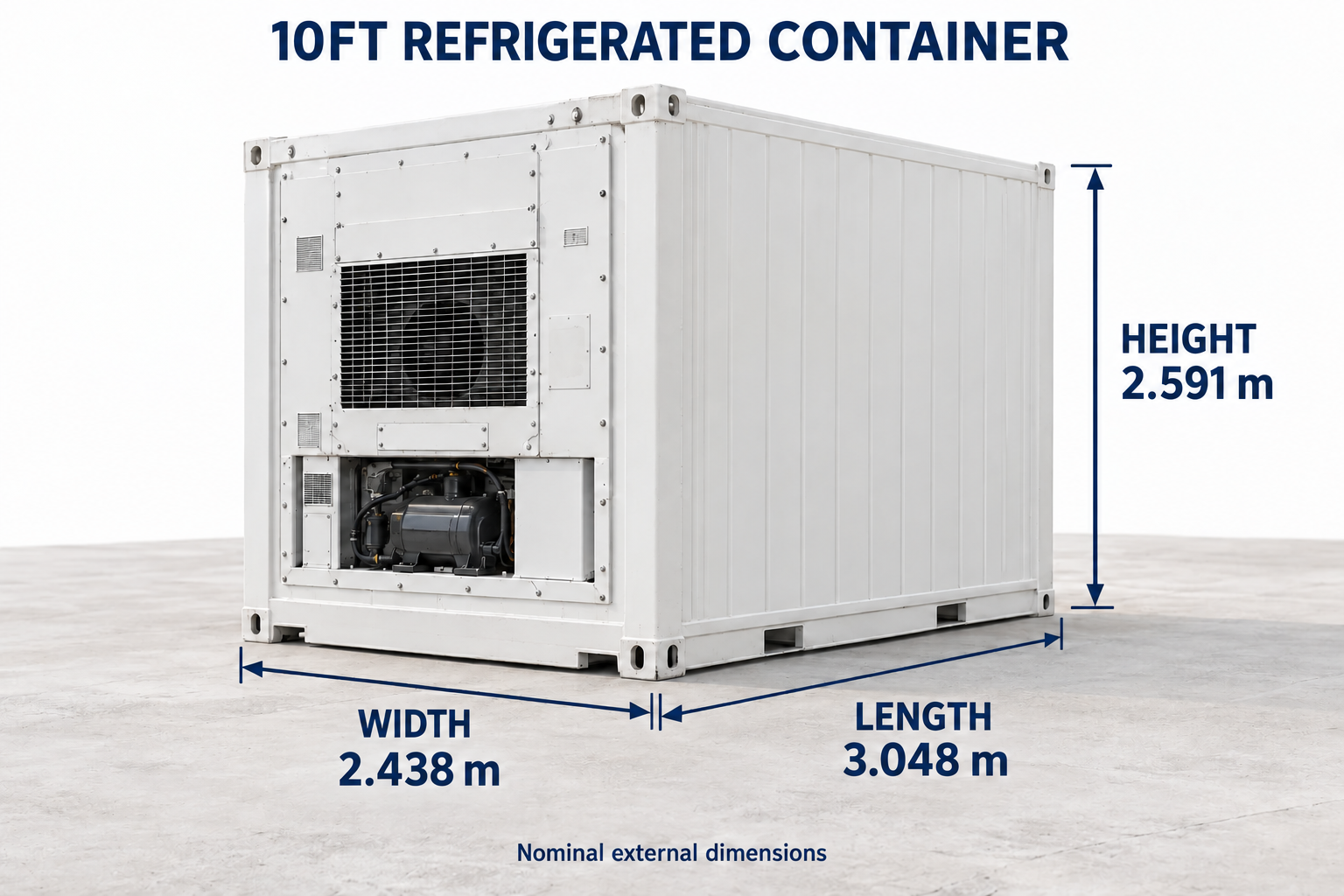
Compact refrigerated storage for smaller loads and sites. Compare this standard-height cargo-door example, then specify the cooling duty, site power and delivered scope.
Request a delivered quote
The supplier confirms the actual unit, working condition and delivery details.
The example below is a nominal 3.048 m × 2.438 m × 2.591 m cargo-door container with an insulated interior and T-floor. Its machinery and insulation reduce the usable room.
Swipe the table to see every column.
| Measurement | Length | Width | Height |
|---|---|---|---|
| Exterior, metric | 3.048 m | 2.438 m | 2.591 m |
| Interior, metric | 2.438 m | 2.235 m | 2.235 m |
| Cargo-door opening | — | 2.234 m | 2.248 m |
These dimensions are examples for particular models. Check the offered unit’s measurements, openings, ratings and usable clearances before planning storage, transport or installation.
Exterior, interior and cargo-door figures describe this one documented example. Door opening and interior height are separate measurements; confirm the actual unit, floor and load line.
Specify packaged dimensions, peak load and the items you need to reach. Confirm the door arrangement and airflow plan before relying on a pallet count.
Describe whether goods arrive already chilled or frozen, or need cooling from warm. Give the batch size, arrival temperature and required completion time.
The cargo-door example uses three-phase supply. Portable designs have their own cooling equipment and connection requirements.
Swipe the table to see every column.
| Operating requirement | What the supplier must confirm | Site confirmation |
|---|---|---|
| Holding temperature | Required setpoint, product temperature and dated test for the actual machine | Airflow, loading, insulation and door-opening routine |
| Cooling duty | Whether the unit can perform the required holding or pull-down duty | Incoming batch size and temperature; local ambient conditions |
| Electrical supply | Nameplate voltage, phase, 50 Hz compatibility, current and connector | Licensed electrician checks circuit, protection, earthing and any transformer |
Confirm the assigned unit’s nameplate voltage, phase, frequency, current and connector. Australian supply is nominally 230 V single phase or 400 V three phase at 50 Hz; a licensed electrician must confirm equipment compatibility, circuit protection and any transformer.
Choose 10ft when a smaller packaged load fits the actual interior and you can provide the selected machine’s supply; compare a portable walk-in if frequent entry determines the door choice.
The standard-height example has a 2.438 × 2.235 × 2.235 m interior. Its 2.234 m-wide × 2.248 m-high opening is a separate measurement: passing the doorway does not establish usable storage height.
Use a loading plan for this cargo-door T-floor configuration. Portable door-specific pallet counts describe a different box and do not establish how items can be retrieved from the shorter cargo-door room.
Confirm the selected equipment is suitable for the Australian site supply: nominal 230 V single phase or 400 V three phase, 50 Hz. Have a licensed electrician check the nameplate, current, connection, protection and any transformer.
Keep the delivered box, refrigeration machine and condition evidence together. A compact footprint does not establish the machine’s working condition or the included service arrangements.
Compare Australian proposals for the same temperature duty, condition, refrigeration equipment and delivery postcode.
Request a current written offer for the assigned unit. Confirm the dispatch depot, availability, applicable GST, transport, unloading and site work. A missing charge is unresolved, not zero.
| Configuration to quote | Equipment evidence | Australian price confirmation |
|---|---|---|
| Used refrigerated container | Unit and machine identity; box condition; dated temperature test; warranty terms | Current total in AUD including applicable GST |
| Used box with replacement refrigeration | Identify the box and replacement machine separately; 50 Hz compatibility; guarantees | Confirm equipment, delivery, unloading and site electrical costs |
| New or one-trip reefer | Actual condition, machinery specification, temperature duty and electrical nameplate | Supplier confirms availability and complete written scope |
Request the machine identity, a dated operating test at the required temperature and checks of alarms, defrost and door seals.
Compare insulation, floor, repairs and equipment age separately. A new motor can be fitted to a used box; request the warranty terms for each.
Have the quote separate equipment, any transformer or conversion, transport, unloading, taxes and site electrical work.
A smaller installed box can still arrive on a long delivery vehicle. Confirm the method for your address and leave room for doors, receiving and refrigeration service.
Confirm the selected equipment is suitable for the Australian site supply: nominal 230 V single phase or 400 V three phase, 50 Hz. Have a licensed electrician check the nameplate, current, connection, protection and any transformer.
No Australian pallet count is established for the offered unit here. The earlier portable-model counts use a different equipment and pallet configuration. Provide your actual loaded pallet dimensions, including whether you use the Australian 1165 × 1165 mm footprint, then obtain a dimensioned plan that preserves airflow, the load line and retrieval access.
Obtain a current Australian quote for the selected configuration. Ask for a total in AUD including applicable GST, with the container or kit, transport, unloading, site work, installation and other mandatory charges clearly itemised.
Include the delivery postcode, packaged load, door routine, target temperature, arrival temperature, site voltage and phase, condition preference and unloading details. Ask for a dated refrigeration test and the complete delivered scope.
Compare the cooling needs and delivery work together.