
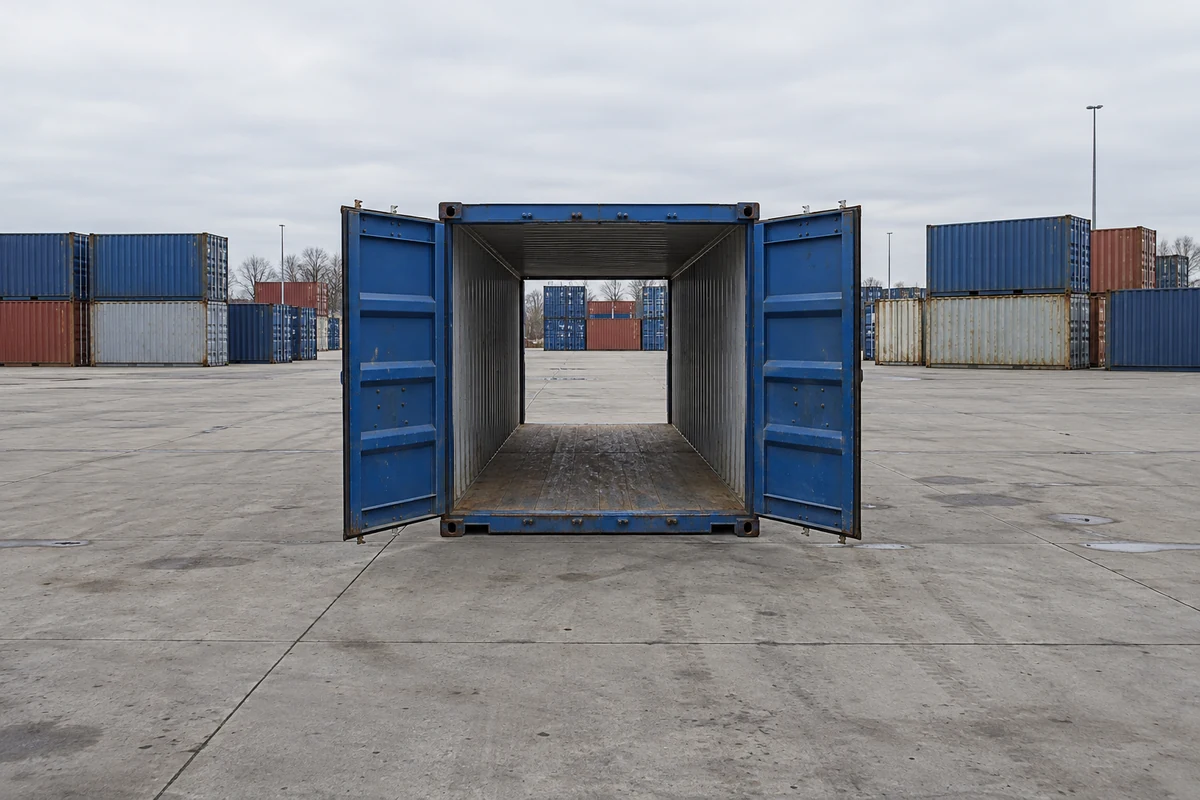
20ft double door container — used
Category: Double Door Shipping Containers
A used 20ft double-door container offers access at both short ends, but the condition of both door sets matters to its usefulness. It can suit a store where stock is reached from either side or a planned partition creates two independently entered zones. Inspect it as a complete tunnel unit, not as a standard box with an assumed second entrance.
20ft-double-door-used-blue · industrial blue
- Nominal length
- 20ft
- Height / build
- Standard · 8ft 6in
- Requested condition
- Used
- Access
- Cargo doors at both ends
Choose a requested finish
- industrial blueQuote this finish
- industrial greyQuote this finish
- olive greenQuote this finish
- sand beigeQuote this finish
- ivoryQuote this finish
Exterior colour is a request; confirm the final finish with the supplier.
Give each entrance its own condition check
Call the ends A and B in your inspection notes. Open every door leaf. Check alignment, seals, hinges, locking bars and thresholds at both ends. Look for different wear on the floor inside each entrance. Ask about end-frame repairs and past water entry. A good entrance at one end does not prove the other is in the same condition.
- List repairs by end so a quotation cannot leave the second door set ambiguous.
Choose through access or two separate zones
For through access, draw door A → stock reached from A → clear centre route → stock reached from B → door B. For a divided store, show the partition and the usable depth of each room. These are different arrangements, so define the purpose before buying a unit with existing shelving or alterations. Remove or account for any fitting that blocks an entrance, hides a damaged area or prevents normal door operation.
- Check previous contents and cleaning requirements for both proposed storage zones.
Keep the second end reachable after installation
Show both entrances on the placement drawing, including the space outside each for opening doors and handling stock. Consider whether a fence, parked equipment or a future building would make one end unusable. Agree the supplied condition before any conversion begins, especially if new partitions or lining will conceal existing surfaces. The useful result is a working two-access store, rather than simply owning a shell that happens to have more doors.
Questions about this model
What if one end opens poorly but I plan to use only the other?
Discuss the defect and its repair explicitly. The unused end still forms part of the enclosure and future access plan. Compare that offer with a standard single-end unit instead of paying for a two-access function you cannot use.
Could an existing partition hide something important?
Yes. Ask how the floor, walls and frame behind the partition were checked, and whether it can be removed. Check the shell's condition even if you like the existing room layout.
How should repairs be documented on a tunnel unit?
Use labelled photographs and a work list for each end, followed by the shared roof, walls and floor. Identify what is repaired, replaced or accepted as-is, and agree how operation of both door sets will be confirmed.
Prepare the delivered quote
For delivery in New Zealand, provide your postcode, access constraints, planned use and preferred door orientation. Request a NZD quote separating the offered container, transport, unloading, placement and applicable taxes.
Read the size and configuration guide →Compare the alternatives
20ft double door container — new / one-trip
Compare a new tunnel container if repairing both used entrances would add too much work.
View this model →20ft standard container — used
Compare one-end access when the second entrance would remain blocked or unused.
View this model →