
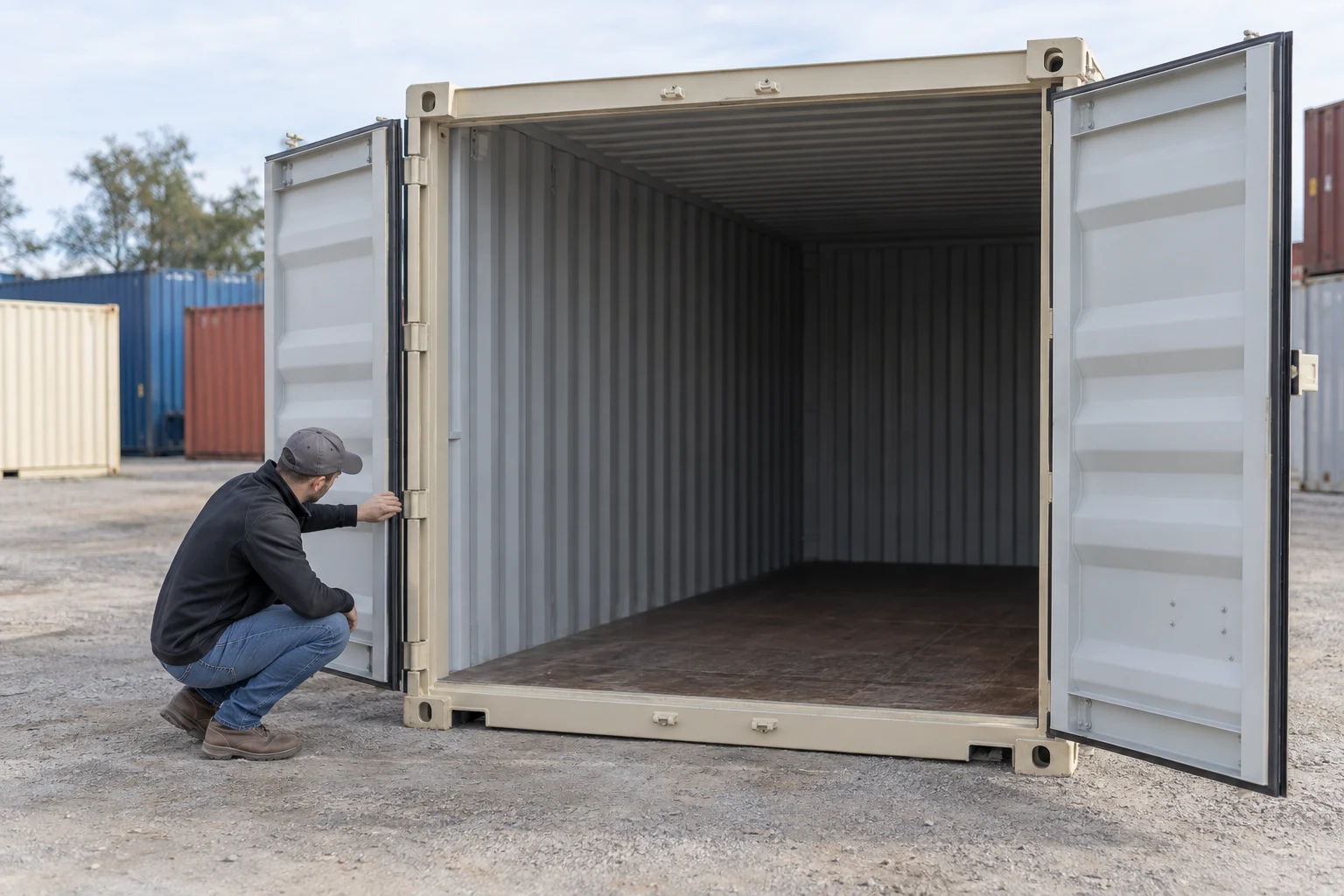
1. Set the use and fit requirements
For storage, list your largest items, their dimensions and how you will move them in and out. For cargo transport, tell the seller the planned use and ask your carrier or forwarder what documentation and acceptance checks are needed.
Compare inside dimensions and door openings as well as outside size. Transport operators' specifications can provide examples, but manufacturers and units vary. If space is tight, ask for the offered unit's actual dimensions.
Before buying a container to convert or occupy, decide what the project needs. A container's shipping specification does not approve its use as a building.
Write down what you need before asking for quotes
| Decision | Put in your request |
|---|---|
| Fit | Largest item dimensions, minimum door opening and space needed to retrieve items. |
| Condition | Required weather tightness, door and floor condition, acceptable repairs and inspection evidence. |
| Delivery | Final postcode, quantity, access restrictions, unloading scope and desired door direction. |
| Unit selection | The pictured unit's container number, or the rules for selecting a unit later and replacing it. |
| Offer | Itemised delivered total, quote validity, payment schedule and inspection or acceptance terms. |
2. Agree on the unit and its condition
The seller may choose the container later from an agreed grade. Ask who chooses it, when you will get its number and photos, and what happens if it does not meet the written requirements. Agree inspection, replacement and rejection terms before paying. Sample photos do not show the unit you will receive.
- Ask for the seller's written condition requirements, permitted defects and repair exclusions.
- Ask whether the photos show the offered unit. Have the seller connect its container number, current photos and written offer.
- Request exterior, roof, interior, floor and door views, plus confirmation that the doors operate. Agree on what can be checked at inspection and delivery.
- Ask about odours, residues, known prior use and cleaning where relevant to your stored goods.
- For cargo use, ask for safety approval and current examination information for the unit, then confirm the carrier's acceptance requirements.
3. Confirm that the unit can reach your site
Give the delivery postcode, entrance and approach details, ground conditions and desired placement. Ask who reviews access and which vehicle and unloading method will be used.
Resolve site preparation and door orientation before the delivery is scheduled. Ask what happens if the operator cannot safely reach or unload at the agreed spot.
Before purchase, ask the local council and building consent authority whether the intended placement and use are allowed. Resolve any required building or resource consent and site work while you can still change the size or location.
4. Compare the complete offer and seller terms
Use the same size, condition, quantity, postcode and delivery scope for each quote. Separate the container, transport, unloading, taxes and optional work. Confirm quote validity and every excluded charge.
Check who sells the container, issues the invoice, receives payment and delivers it. Read the payment schedule and the rules for cancellation, returns, inspection and reporting problems. Ask who handles each problem. Keep the offer, photos and reports about the unit, and order confirmation together.
Prepare and review your project summary, then send it through the quote form with your consent. You can also copy or download it. A supplier must confirm availability, price and delivery.
For a NZ purchase, ask for an NZD/GST breakdown, the trading entity, the actual unit or allocation terms, and the agreed transport/unloading scope. Consumer rights depend on the transaction; an as-is label or seller warranty must not be assumed to remove applicable Consumer Guarantees Act rights. For imported units, ask the seller for the relevant biosecurity clearance evidence.
5. Agree on inspection and arrival checks
Before paying, ask when you can inspect the unit, how soon you must report a problem and what records the seller needs. Check what happens if a different unit arrives, it is damaged in transit or its condition does not match the agreement.
On arrival, follow the operator safety instructions. When safe, photograph the unit number and condition, check the agreed door direction and compare the delivered unit with the order. Use the agreed reporting process promptly if you find a discrepancy.
Buying questions
What should I decide before asking for a container quote?
Specify the use, minimum usable space and door opening, required condition, quantity, delivery postcode and unloading scope. Ask for the unit identification or selection process and complete written terms. Those decisions make competing offers easier to compare.
Can a storage container be used to ship cargo?
Do not rely on a storage listing alone. Confirm the unit's structural inspection, CSC status and suitability for your intended cargo movement with the seller and carrier.
What should a quote include?
The size and condition, quantity, unit selection or identification, delivered postcode, transport and unloading scope, taxes, extra charges, validity and seller terms.
What if the seller cannot identify the unit before payment?
Get the rules for choosing or replacing the unit in writing. Check which defects are allowed and how you can inspect or reject it. Sample photos do not show the condition of a container chosen later.