
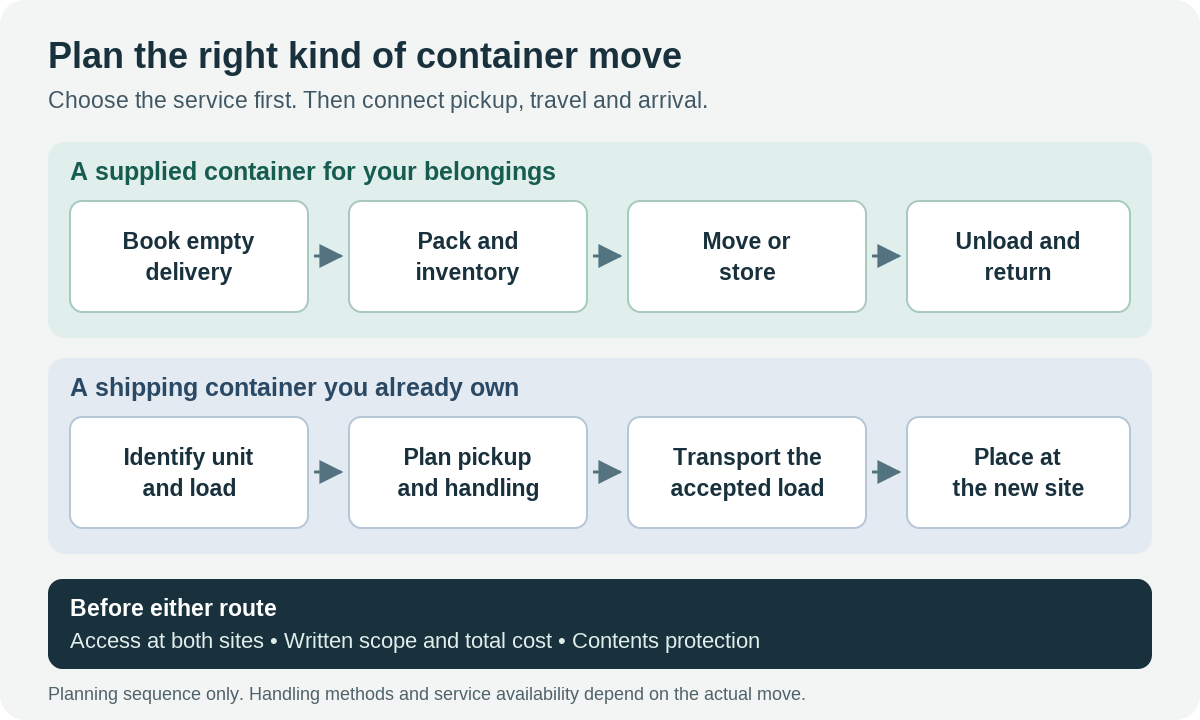
1. Choose the service before choosing a container size
A moving company can supply a portable container as part of its service. You arrange loading time, transport of your belongings and the container's return. Moving a container you own is a separate transport job. The provider needs its identity, condition and load. Buying a storage container does not arrange either service.
Choose a supplied-container service around its actual interior, door opening and permitted load. Do not use the dimensions of a 20ft or 40ft ocean container to size a different moving module. List large furniture, awkward items and anything that must stay upright before selecting the size or number of containers.
| Your situation | The useful starting point | Resolve before committing |
|---|---|---|
| Moving household belongings in a supplied container | An inventory, both addresses and the dates you can load and unload. | Who supplies the container, who packs and loads, which transport and storage stages are included, and when the container is collected. |
| Moving an empty container you own | Unit identification, size, photos, condition and pickup position. | How the operator will get it off its current supports, transport it and place it at the destination. |
| Moving your own loaded or modified container | The unit record plus contents, added fittings and weight information. | Whether the provider accepts that exact combination and who handles the contents and the unit during transport. |
2. Plan a supplied container from delivery through return
Use this sequence to turn a moving date into a complete booking. Add the storage stage only when your move needs it.
Keep the overnight essentials, documents, medication and items needed before delivery outside the shipment. For everything going inside, get the provider’s loading and excluded-items instructions before packing. A booking for a container and transport is not evidence that packing labour or loading help is included.
| Stage | Make the decision now |
|---|---|
| Empty delivery and loading | Reserve the placement area and loading period. Decide whether you will load or hire help, and keep the inventory with the booking. |
| Pickup and travel | Agree the collection window, destination and contact for changes. Record who performs the transport. |
| Storage, if needed | Choose where the container waits, whether you can access the contents and how redelivery is requested. |
| Delivery and unloading | Match arrival to when you can actually occupy and access the destination. Arrange any unloading help separately if it is not included. |
| Empty-container collection | Set the return or collection arrangement and identify the event that stops the rental charge. |
3. Check access at both addresses
For an apartment or a site without a suitable placement area, settle the loading method before paying: an accepted alternative location, timed access or a different service. Do not plan to solve that problem after the container arrives.
| Record at each address | Why it changes the plan |
|---|---|
| Placement and loading access | Mark the position and door direction, the walking route to the building and any space shared with other users. |
| Ground, slope and obstructions | Let the operator assess the setup area and tell you what must change before arrival. A photograph is not a ground-capacity assessment. |
| Property and street permissions | Identify who controls the driveway, parking area or street space. Resolve the permission and local placement requirements for the proposed dates. |
| Contact and time window | Name the person responsible for access and directions. Confirm whether they must be present for the particular service. |
| Fallback if access fails | Agree who arranges an alternative position, extra handling or a new visit, and how those changes are charged. |
4. If you own the container, specify the handling at both ends
Photograph the container number, doors, visible damage, alterations and current supports. Say whether it is empty or loaded. Record the original unit details separately from the weight of contents and added fittings. A plate or old specification does not give its current loaded weight.
Ask the transport provider how it will move the unit from its current spot to the new one. Both sites must suit the vehicle and its loading or unloading method. If separate lifting equipment is needed, agree who supplies and coordinates it at each end. A road-transport quote does not necessarily include either lift.
- List fixed additions and loose contents separately, with photos and the source of any weight estimate. Flag unknown weights as unknown.
- Obtain acceptance for moving the unit loaded before packing it for transport. The provider may require a different load or a different arrangement.
- Agree who prepares and secures the contents, who secures the unit to the vehicle and who releases the unit for access at the destination.
- Include the new supports and door direction in the transport instructions. Let the operator manage the handling. This guide does not specify lifting points, lifting gear or how to secure the container to the vehicle.
5. Make the storage gap part of the schedule
Write down four dates: last access to the old home, container pickup, first usable access to the new home and empty-container collection. The gap between them determines what you need to store and for how long. A possession date and a practical unloading date may be different.
Suppose the old driveway must be empty before the new home is ready. Leaving the container there will not work. Compare a booked storage period with an agreed later arrival. Ask what happens if the new date slips. This example shows a scheduling problem; it does not promise storage or redelivery on demand.
| Storage choice | Useful when | Check before choosing |
|---|---|---|
| Container remains at an approved property | You have permitted space and need access while loading or waiting. | The allowed placement period, security, rental period and eventual pickup. |
| Container waits at a provider’s facility | The origin must be cleared before the destination is ready. | Contents-access arrangements, storage billing, lead time for redelivery and any handling charges. |
| Goods move into separate storage | The selected moving service cannot provide the required storage interval. | The additional unload and reload, labour, vehicle trips and protection during each handover. |
6. Compare the cost of the whole move
Build a planned total from the committed, nonrefundable amounts for your schedule. Add only items not already included in a package. Keep conditional charges alongside that total, with their triggers, and mark unpriced items as unknown rather than zero.
If two offers cover different storage periods, compare both at your expected duration and again at a plausible later delivery date. That exposes an extension cost without inventing a national average or assuming the lowest initial quote stays lowest.
For NZ domestic moves, distinguish within-island road transport from an inter-island job and include both-end pickup, unloading and storage. Confirm whether the operator will move an owned container, a hired container or only its own supplied system. Compare NZD totals with the same GST basis and service period.
| Cost component | Record in the comparison |
|---|---|
| Container use or hire | Size and quantity, billing period, minimum term, extensions and the event that ends charging. |
| Local deliveries and collections | Every included visit at the origin and destination; identify any separately priced pickup or redelivery. |
| Main transport | The two endpoints, accepted load, number of trips and what the transport amount excludes. |
| Packing and handling | Materials, loading labour, unloading labour and any separate lift or transfer of goods. |
| Storage | Where, for how long, how partial periods are charged and whether access or handling costs extra. |
| Protection and taxes | The selected protection, any deductible, GST and other stated charges. |
| Changes and access problems | The trigger and amount or calculation basis for waiting, failed visits, cancellation, rescheduling or an extended term. |
| Upfront cash | Deposits and payment dates. Keep a genuinely refundable deposit separate from the nonrefundable cost. |
7. Match the paperwork and protection to the service
For a New Zealand household move, identify the contracting business and actual carrier and read the inventory, quote and transport/storage agreement. Keep verified contacts, agreed collection/delivery arrangements and responsibility at each handoff in one record.
Ask what protection or insurance applies to the specific goods and movement, whether you pack/load yourself, any excluded contents, excess and claim deadline, and who receives a claim. An ordinary container sale warranty does not insure household goods in transit. Compare these terms before accepting the service.
8. For an international move, define the service endpoints
For a move into or out of New Zealand, separate the freight-forwarder scope from customs/biosecurity clearance, destination charges and the final inland delivery. Ask for the container and household-goods handling terms, insurance, inspection basis and excluded charges in writing.
Imported containers, including empty units, must meet MPI biosecurity requirements; household goods and wood packaging have their own requirements. Ask who supplies the quarantine declaration, arranges clearance and pays for inspection, treatment, storage or delays. A domestic storage grade alone does not establish export-transport suitability.
Prepare your moving brief
Copy these fields into your notes and complete one version for every provider. Attach the same inventory and site photographs to each enquiry.
Use your completed plan to ask a provider for the service you need. ContainerPick does not book household moves, haulage or storage. The separate container-purchase request builder helps you prepare a buying enquiry. It does not reserve this move.
| Field | Your entry |
|---|---|
| Move type | Supplied moving container / empty unit I own / loaded or modified unit I own. |
| Inventory or unit | Largest items and packed dimensions; container identification and modifications where applicable; weight source and unknowns. |
| Origin and destination | Addresses, postcodes or countries, contacts, site photos, proposed position and door direction. |
| Dates | Last origin access; pickup window; earliest destination access; unloading period; final collection. |
| Storage | Location, expected duration, contents access and the alternative if the destination is delayed. |
| Responsibilities | Packing, loading, unit handling, transport, storage, unloading and empty-container collection. |
| Comparable offer | Itemised total, included periods and trips, payment dates, refundable deposits, exclusions and change charges. |
| Protection and handover | Selected cover, exclusions, inventory/condition record, required presence and reporting process. |
Buying questions
Do I need to buy a shipping container to move my household belongings?
You can use a moving-container service instead of buying a container. Compare its loading time, transport, storage and return arrangements with buying and later moving your own unit. If you buy, also decide where the container will go after the move.
Can my own shipping container move with everything still inside?
Only after the transport provider accepts the actual unit, contents and weight details. Agree who secures the goods, how the container will be handled at both sites and what protection applies. Accepting an empty delivery does not mean the provider accepts a loaded move.
Does a monthly container-rental price include the move?
Check every service and date in the offer. List local visits, main transport, handling, storage and return separately, then add the agreed costs. A monthly price alone does not tell you the cost of moving between two addresses.
Official sources for this move
Use the carrier guidance for the service contract and Customs' household-effects guidance for an international arrival; confirm the actual route, handling and local access with the responsible operators and authorities.