
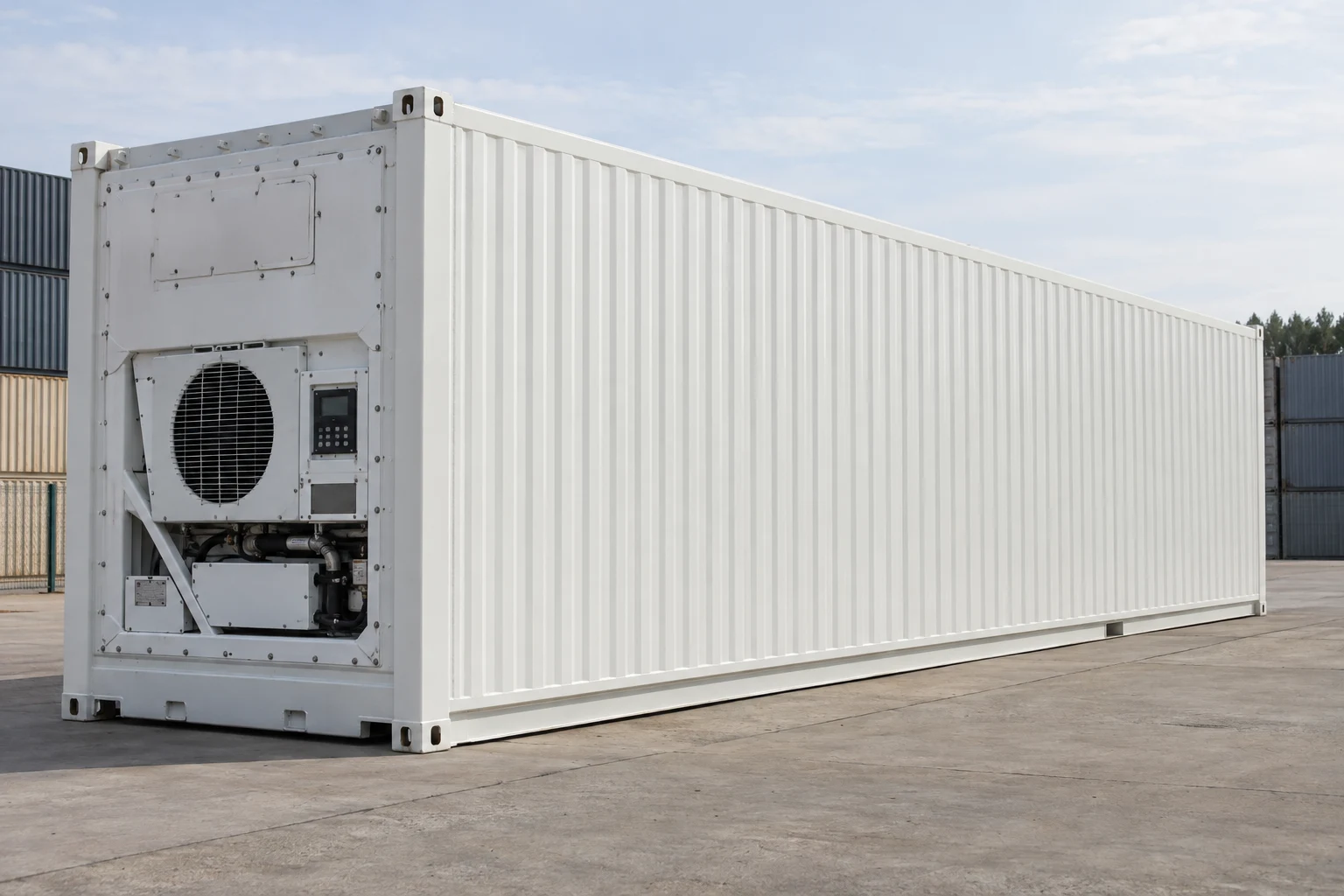
Specify the cold-storage duty before choosing equipment
Identify whether the job holds already chilled goods, holds frozen goods, cools warm arrivals or freezes a batch. Specify product temperatures in °C, packaged dimensions, peak load and time requirements.
Describe door openings, receiving, individual picking and seasonal operation. The supplier must select and demonstrate the actual configuration for these conditions.
Compare actual metric dimensions
These NZ-market model examples have separate doors, insulation and equipment. Confirm the allocated unit, floor, marked load line and finished doorway before loading.
A walk-in configuration and a marine cargo-door reefer can share a nominal length while having different usable room. Keep each model’s dimensions and operating requirements together.
| NZ format example | Outside L × W × H | Inside L × W × H | Door W × H |
|---|---|---|---|
| 10ft HC | 2.99 × 2.44 × 2.9 m | 2.28 × 2.29 × 2.59 m | 1.79 × 2.46 m |
| 20ft HC single phase | 6.06 × 2.44 × 2.9 m | 5.19 × 2.29 × 2.59 m | 1.79 × 2.46 m |
| 20ft GP ISO | 6.06 × 2.44 × 2.6 m | 5.45 × 2.29 × 2.28 m | 2.29 × 2.26 m |
| 20ft HC pallet wide | 6.06 × 2.5 × 2.9 m | 5.45 × 2.39 × 2.57 m | 2.39 × 2.53 m |
| 40ft HC ISO | 12.2 × 2.44 × 2.9 m | 11.6 × 2.29 × 2.57 m | 2.29 × 2.54 m |
| 40ft GP standard | Confirm exact exterior | 11.554 × 2.29 × 2.238 m | 2.29 × 2.204 m |
Match chilled or frozen duty to 50 Hz site power
New Zealand sites use 50 Hz electricity, with nominal 230 V single-phase and 400 V three-phase supplies. Have an electrician match the actual machine’s voltage range, phase, 50 Hz compatibility, current, connector and circuit to the site before delivery.
The ranges below belong to a documented local supplier range. A separately sourced or converted unit needs its own nameplate, operating test and temperature specification. Single-phase chilled storage does not establish frozen-storage capability.
A selectable setpoint does not establish pull-down speed or the time to freeze a warm batch. Specify incoming temperature, batch mass, target temperature and required completion time.
| Separate supplier configuration | Published range | Connection example |
|---|---|---|
| Single-phase chiller range | 0°C to +20°C | 15 A / 240 V supplier rating |
| Three-phase refrigerated range | −25°C to +20°C | 32 A / 415 V supplier rating |
Plan packaged loads, airflow and access
Use the actual packaged load. The NZ blue-pallet reference is 1,200 × 1,000 mm; an Australian pallet is a different 1,165 × 1,165 mm footprint. Allow for wrapping, airflow and retrieval; container length alone cannot establish a safe pallet count.
Ordinary examples with a 2.29 m interior width cannot fit two 1.165 m Australian pallet widths side by side. A 2.39 m pallet-wide box is a separate configuration; it still needs the manufacturer’s clearance and airflow plan.
For NZ 1.2 × 1.0 m pallets, sketch the actual orientation, wrapping and removal sequence in the offered unit. Reserve machinery-end and door clearance plus an aisle where goods need individual access. Do not treat every geometric position as validated storage.
Plan unloading, electrical connection and machinery access
Give the operator the full address, suburb/town, region and postcode, with access photographs. Confirm HIAB or swinglift delivery, the actual unloading side, door direction, overhead services, firm ground and the complete placement scope.
Leave the refrigeration end clear for ventilation and maintenance to the assigned machine’s instructions. Arrange any site connection, commissioning and safe access before the unit arrives.
Moving an empty cold-storage box is separate from transporting cold goods under power. Agree on the transport duty, load and power arrangements with the actual operator.
Receive the unit with its operating and service records
Match box and machine identifiers to the quote, condition photographs and test report. Check the floor, doors, seals, insulation and any repairs at delivery.
Ask for operation and alarm demonstrations, emergency release where provided, defrost/temperature controls and safe access. Keep the operating instructions, service arrangements and written warranty scope.
Estimate running cost from measured NZ operation
Ask for measured kWh over a representative period for the proposed machine, load, ambient conditions and door routine. Use the energy price on your own New Zealand tariff, including its GST basis.
Energy charge = measured kWh × your NZD/kWh tariff. Add any relevant fixed or capacity charges separately. Nameplate amperage and one maximum operating point cannot establish a daily bill.
Compare monitoring, alarms, service arrangements and breakdown response in the written scope. A device with remote connectivity does not establish a supplied subscription or a monitored response service.
Prepare the same brief for every supplier
Give the operator the full address, suburb/town, region and postcode, with access photographs. Confirm HIAB or swinglift delivery, the actual unloading side, door direction, overhead services, firm ground and the complete placement scope.
State size, condition, intended use, quantity, preferred delivery date and any fittings. Request unit photos and the complete delivered amount in NZD, with GST, inspection, unloading and extra access costs itemised.
Buying questions
Can this reefer run from a normal household outlet?
Confirm the actual machine. The documented single-phase chiller range requires 15 A / 240 V; three-phase units have separate requirements. A household outlet, plug adapter or smaller box does not establish compatibility. Have an electrician check the nameplate, 50 Hz supply, current and connector.
How many pallets will fit?
Use the actual packaged load. The NZ blue-pallet reference is 1,200 × 1,000 mm; an Australian pallet is a different 1,165 × 1,165 mm footprint. Allow for wrapping, airflow and retrieval; container length alone cannot establish a safe pallet count. Obtain the proposed model’s loading instructions and a floor plan with clearance and retrieval space.
Does an insulated container provide refrigeration?
A non-operational reefer or insulated shell has no active cooling. Request operating refrigeration, a dated run test at your required temperature and written equipment warranty terms if temperature control is required.
What belongs in the full delivered price?
The allocated box and refrigeration machine, repairs/testing, accessories, delivery, unloading, electrical setup, commissioning and GST. Compare the same duty and site in each proposal.