
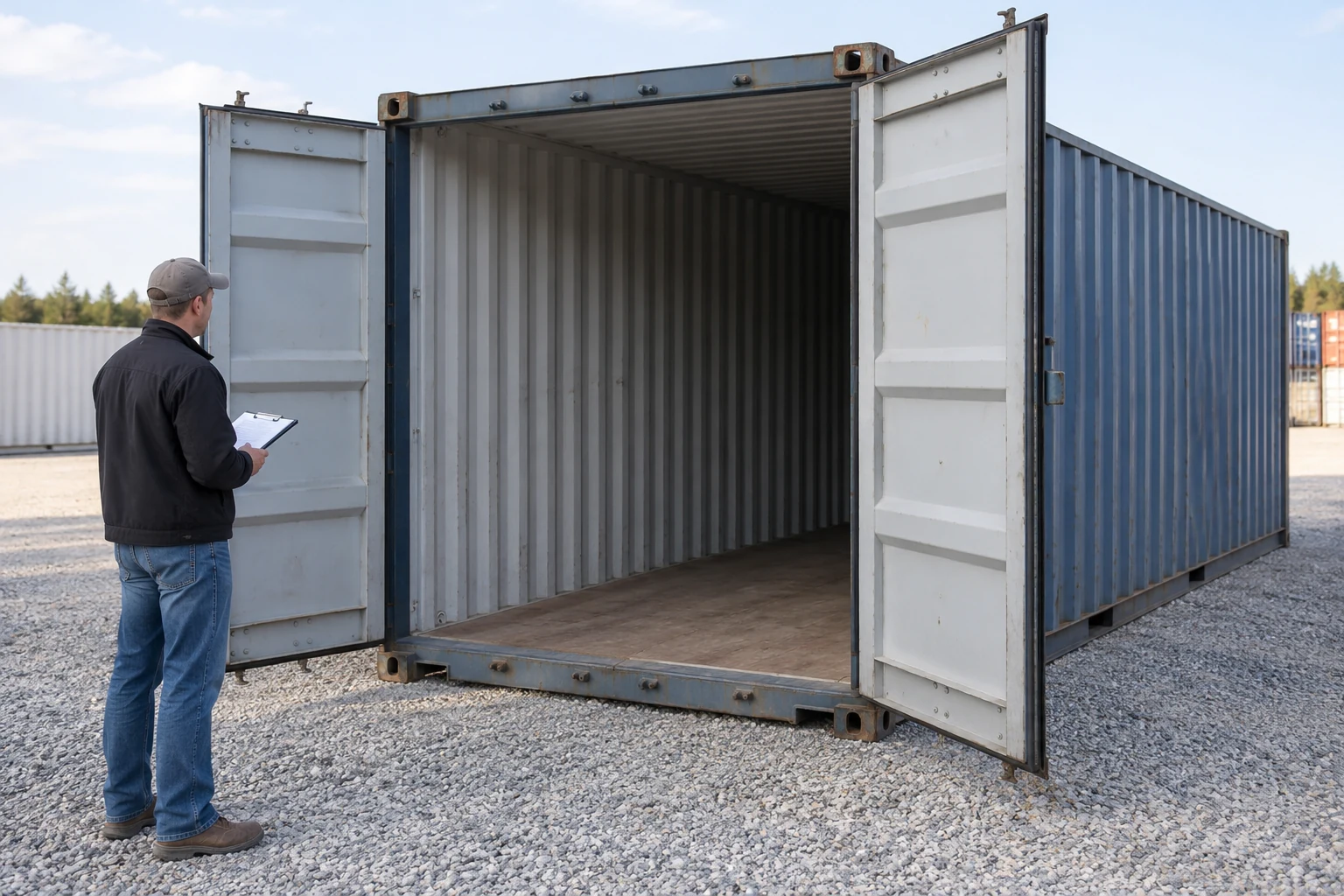
What WWT, Cargo Worthy and One Trip tell you
Use the label to identify the claim you need to check. These terms do not form one universal grading scale.
| Description in the offer | Claim to clarify | Evidence that matters |
|---|---|---|
| WWT — wind and watertight | The seller describes a container that keeps out wind and rain. Previous repairs or cosmetic wear may be allowed. | The written weather-tightness scope, evidence of door and seal condition, and findings on holes, leaks and repairs. |
| Cargo Worthy — CW | The seller describes condition suitable for cargo service under its stated criteria. | A unit-linked condition report, its inspection criteria and any unfinished repairs. Check transport documents and acceptance separately. |
| One Trip | Common Australian sales usage describes a container brought from overseas with one cargo load before sale. Handling marks can still be present. | The seller's written use-history description and condition terms, plus evidence for the unit allocated to the order. |
Check the records your use requires
- Stationary storage: compare whether each offer documents weather resistance, usable doors and the floor condition your contents need. Decide which cosmetic defects you can accept. A more impressive label does not resolve a missing door or floor assessment.
- Cargo transport: add the applicable safety approval, examination status and the intended transporter's acceptance requirements. Resolve these for the planned movement before relying on a seller's cargo-worthy description.
- Conversion: have the shell, damage and repairs checked for your project. A sales grade does not prove that the finished building or alterations will be suitable.
For international or interstate sea transport involving Australia, confirm the actual container’s approval, examination, maintenance and marking requirements with the carrier and relevant professionals. Confirm the applicable Marine Order 44 requirements for the planned shipment. A sales grade or storage inspection does not by itself establish acceptance for the planned shipment.
Is used better value than new or one-trip?
A used unit can be better value if its recorded condition meets your needs and its full cost is lower. A newer label does not, by itself, mean fewer repairs or a better delivered offer.
For stationary storage, weather resistance, working doors and a suitable floor matter more than an impressive label. WWT does not promise that everything stored inside will stay dry in every situation. Plan moisture control and security separately.
If appearance is important to your project, specify the dents, corrosion, repairs or finish you can accept in the order. If the unit will be modified, resolve project suitability separately rather than infer it from a sales grade.
| Option in the offer | What to establish | Compare in the budget |
|---|---|---|
| Used | The actual wear, repairs and condition evidence; decide which cosmetic defects are acceptable. | Delivered price and any independently scoped work needed for your use. |
| New / unused | The seller’s stated use history and the condition of the allocated unit. Keep unused separate from one-trip. | The complete delivered premium, if any, and what useful condition difference it buys. |
| One-trip | The written limited-use description, handling marks and actual-unit condition; do not treat it as unused. | The complete delivered total against another option that meets the same requirements. |
Match the report to the unit and the work performed
A report headed “inspected” is useful only when you can tell what it covers.
Check whether the offer is for a specific container or one to be chosen from a category. For a known unit, match its number on the offer, photos and report. Sample photos show a possible appearance. They cannot show the condition of a different unit.
Some sellers choose the unit later. Ask when you will get its number, photos and condition report. Get the selection rules in writing and ask what happens if the unit does not meet them. Compare these terms rather than assuming every sale lets you choose a specific container in advance.
An inspector's credentials describe the person. They do not establish a result for your container. IICL inspector certification, for example, is distinct from a CSC examination; IICL states that its certification is not mandatory to carry out that examination.
- Date and stage: when was the inspection performed, and was it before or after the repairs now included in the offer?
- Criteria: which inspection criteria or manual, and which edition where applicable, did the examiner use? Does the report state a result against those criteria?
- Inspection: who checked the unit? Which areas did they inspect, and which areas or checks were excluded or inaccessible?
- Since inspection: what repairs, damage or alterations have occurred? Ask for current records or photos of them.
Check what the condition report covers
Compare the same four points in both offers. A photo shows what was visible from that angle. Testing how something works or examining it answers different questions.
Do not confuse 'not checked' with 'no defect found'. If the report leaves out an important area, note the missing check. Do not treat it as a full pass.
| Condition area | Useful evidence | What remains unresolved without it |
|---|---|---|
| Doors and seals | A recorded open-close-lock check and views of hinges, locking gear and gasket condition. | A closed-door photo does not show how the doors operate or whether seals were examined. |
| Floor | Findings on damage, repairs, protrusions, staining and any areas hidden from view. | A doorway photo may leave the far end or covered areas unexamined. Appearance alone does not establish suitability for a particular cargo or load. |
| Corrosion and structure | Findings that locate corrosion and damage on the frame, walls and roof, with the inspection criteria used. | A distant photo or fresh finish cannot settle the extent of damage. Do not rate structural condition from colour alone. |
| Repairs and weather resistance | The repair locations, work included, completion record and relevant follow-up checks. | A promise to repair is still pending work. A photo of a patch alone does not establish whether it was checked for leaks. |
For transport, keep three records separate
For international cargo transport, the seller's condition report is only one document to check. Also check these records for the actual unit and planned journey:
- Safety approval: find the offered unit's CSC safety approval plate. A photo records the plate's markings, but does not show the container's current physical condition.
- Examination status: identify the applicable scheme. Under periodic examination, check the next examination date. Under an Approved Continuous Examination Program (ACEP), confirm the applicable program and the unit's status under it, including after sale. An old marking alone does not answer those questions.
- Transport acceptance: ask what the intended carrier needs for the container, cargo and journey. Check which documents or photos it requires and whether it has accepted the unit. Requirements can vary by carrier. The seller's label does not replace this check.
Put both offers on the same written terms
Make a separate column for Offer A and Offer B in your comparison notes. Complete the following record for each, using the seller's actual wording and the date of the offer.
| Comparison point | Record for each offer | Decision it supports |
|---|---|---|
| Unit and evidence | Specific unit number or allocation stage; photo/report references and dates; unexamined areas. | Can you assess the unit now, or are you comparing a documented selection process? |
| Permitted defects | Which dents, corrosion, floor damage, marks and previous repairs the seller allows within the quoted condition. | Do both offers meet the same requirements, despite different grade names? |
| Work included | The particular repairs promised, who performs them, completion stage and evidence to be provided afterward. | Is the quoted condition already documented or dependent on unfinished work? |
| Written coverage and exclusions | The condition commitments, any warranty scope and duration, exclusions and reporting requirements. | Which problems does the seller actually agree to address? |
| Allocation or substitution | When a unit is allocated, whether substitution is allowed, and what condition and evidence requirements apply to a replacement. | Would a replacement still meet the requirements you used to choose? |
| Discrepancies at receipt | How and when to report a mismatch, what evidence is requested, who decides the response, and the agreed responsibility for repair or transport costs. | Is there a defined response if the received unit differs from the written order? |
Will an as-is container still save money after repairs?
An as-is offer is worth comparing only when you understand the disclosed defects, the work your use requires and the written acceptance terms. A low unit price with unknown necessary repairs is an incomplete budget.
For example, a cheaper unit may have an unchecked floor. Another may have a report on its own floor and doors. This tells you what still needs checking, not the repair cost or which unit is physically better. Do not allow zero for repairs until the necessary work is settled.
| Record for the as-is offer | Decision before paying |
|---|---|
| Defect and inspection scope | Record each disclosed defect, unexamined area and inspection opportunity for the actual unit. Do not turn a sample photograph into a condition assessment. |
| Required work | Obtain an independent scope and estimate where work is needed. Separate necessary repairs from optional cosmetic work. |
| Delivered and repair total | Add the quoted delivered purchase total and required separately priced work. Keep missing estimates marked unknown. |
| Acceptance and response | Read the actual condition, inspection, substitution and discrepancy terms. Do not infer a remedy from the label. |
| Acceptable alternative | Compare a unit that already meets your requirements, on the same delivery and tax basis. Choose only after the essential condition and budget questions are resolved. |
Choose using the complete comparison
Imagine one WWT offer comes with a dated report on that unit's doors and floor. A CW offer has only sample photos and says nothing about the inspection. The first gives you more information to check. It does not prove the unit is physically better. Ask what records and written promises the second seller can provide.
Choose against your essential requirements, then compare the remaining work and obligations. Keep an unpriced repair, inspection or remedial delivery cost unresolved. Record the seller's contractual commitments, but consumer guarantees may apply independently of warranty or sale terms and cannot be excluded where they apply. Confirm their scope and exceptions for the actual purchase.
Use the size-and-condition product pages below for product details and buying options. The buying guide covers the wider purchase process; the scam guide covers seller and payment verification.
Buying questions
Do I need WWT or cargo worthy for stationary storage?
Choose a condition that suits your contents. Check the promised weather resistance, doors, floor and repairs for the actual unit or its selection process. A cargo-worthy label does not settle these points. If you plan to transport cargo, check the separate transport documents and carrier's acceptance rules too.
Is a new container the same as a one-trip container?
Keep New / unused and One-trip separate. Ask the seller to state the use history and condition of the unit it offers. Common one-trip sales language describes limited cargo use; it does not mean the unit has never been used.
Can I judge an as-is container from a low advertised price?
No. Check the defects, what was inspected, necessary work and written acceptance terms. Then compare the full delivered cost plus repairs with a suitable alternative. Costs that have not been confirmed remain unknown.