
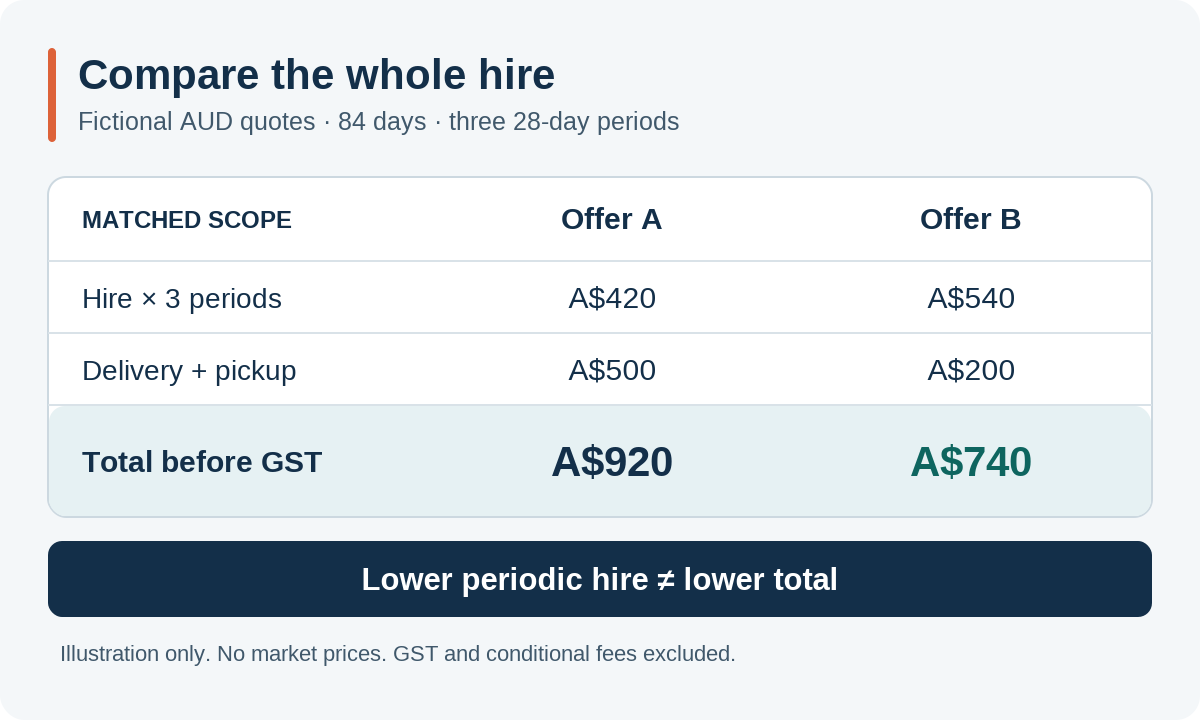
Build a full-term hire comparison
Use one column for each written offer. Write unknown if a price or included service has not been confirmed. A blank does not mean zero.
Planned hire expense = rent for the billable term + delivery and placement + collection + required extras + applicable taxes − confirmed credits. This is a cost worksheet, not a supplier tariff.
Keep a separately refundable deposit outside the expense total, but include it in the cash you need to pay upfront. Record its refund conditions. If a deposit is applied to rent, count that hire charge once rather than adding the deposit again. Any later deduction belongs in your final reconciliation.
| Cost or term | What to enter |
|---|---|
| Container and use | Size, door arrangement, condition, quantity and dry-storage or specialist use. Match these before comparing prices. |
| Hire charge | Rate per unit, billing-period length, minimum term and number of billable periods for your actual dates. |
| Delivery and placement | Transport to the address, unloading and positioning. Identify anything priced separately. |
| Collection | Return transport and loading, including whether the amount is fixed or will be quoted later. |
| Required extras | Any required protection charge, accessories or other recurring fee, with its billing basis. Count an included charge only once. |
| Taxes and credits | Quoted applicable taxes and confirmed discounts or credits, with the items to which they apply. |
| Conditional charges | The trigger and price for waiting, access failure, extra trips, cleaning, damage or a change of location. Keep untriggered charges separate. |
| Cash due and deposit | Payment dates and any deposit, including whether it is prepaid rent or a separate refundable security amount. |
Translate the advertised rate into your actual dates
Hire terms can use four-week cycles or calendar months. Those periods are not interchangeable. Ask for the billing start, the event that ends billing, the minimum term, and any rule for a partial final period.
If an agreement charges every started 28-day period in full, divide the chargeable days by 28 and round up, then apply any minimum term. Under that specific rule, 84 chargeable days use three periods; 85 use four. This calculation does not apply to a contract that prorates the final period.
For a calendar-month offer, request the actual billing schedule for your start and end dates. Do not turn a quoted monthly amount into a daily rate unless the agreement says to do so.
- Ask how much one additional day and one additional billing period would cost at your expected finish date.
- Record whether the rate can change at renewal.
- Resolve whether rent stops when you request collection, when the provider confirms termination, or when the container is collected.
Check the finish date before comparing a monthly rate
A low rate is not a complete hire price until you know the chargeable end date and the collection terms.
| Record from the agreement | What your comparison needs |
|---|---|
| Planned ready-for-collection date | The date the empty, accessible container will be ready; keep it separate from the date you request pickup. |
| Required notice | The notice period and contact method, plus a record of when the provider receives your notice. |
| Event that stops rent | The exact contractual event: notice, accepted termination, collection or another stated trigger. Do not assume these happen on the same date. |
| Final-period rule | A full-period charge, prorated amount or other written rule, applied to the chargeable dates. |
| Delayed or unsuccessful collection | Who is responsible, whether rent continues, and any waiting or repeat-visit charge under the offer. |
Advertised hire rates in Australia
Rates published by hire companies on the date shown, for one 20ft container, in the billing unit each company uses. Delivery, collection and deposits are extra unless the row says otherwise.
| Container | Advertised price | Details |
|---|---|---|
| 20ft hire | A$90–A$120 | per month · ex. GST · checked 16 Oct 2026 |
Convert every offer to the same billing period, then add delivery, collection and the minimum term before comparing totals.
Compare 20ft and 40ft hire options without mixing services
Request a separate full-term total for each size that could meet your storage need. Describe what must fit, how you will retrieve it and the available placement area. A rate for a 20ft container does not establish the rate for a 40ft container, and twice the nominal length does not establish twice the rent.
Keep ordinary dry storage separate from refrigerated storage, an office or a container-move service. The hire charge for keeping an empty unit at your site does not establish permission or a price for moving it with your goods inside. Specify the intended service before comparing offers.
- Use the same dates, address, quantity and required condition.
- Match the door arrangement and any accessories that you actually need.
- Ask whether delivery and later collection are feasible at the proposed position; account for any required work you arrange separately.
Plan collection before the last paid period
Get the required notice period, contact method and collection process in writing. Asking for pickup does not prove that billing has stopped. Keep the confirmation and ask what happens if collection is delayed.
Confirm the return condition, emptying and cleaning requirements, lock removal and the access needed by the collection vehicle. Take dated condition photos when the unit arrives and when it is ready to leave. Record who will review a disputed cleaning or damage charge.
| Change to plan | Question to resolve before booking |
|---|---|
| Finish earlier | Does the minimum term still apply, and is any unused period refundable? |
| Stay longer | What is the renewal rate, and can one extra day trigger a whole new period? |
| Move the unit | Is relocation permitted, who can perform it, and what transport charge applies? |
| Collection cannot proceed | What happens to rent and any failed-visit charge if the unit is not empty or accessible? |
If the end date is uncertain, compare buying over the same horizon
Compare the full hire total at your likely finish date and at a longer fallback date with the complete purchase budget over those same dates. For ownership, include delivery, required work, maintenance and eventual removal or sale costs where relevant.
An expected resale amount is an assumption until there is a real buyer and an agreed price. Keep a no-resale scenario alongside it. Do not infer a universal rent-versus-buy deadline from a monthly hire rate or assume ordinary hire payments build ownership.
Should you hire or buy for six, twelve or twenty-four months?
There is no universal break-even month. Compare written hire and purchase offers for the same usable container, address and service scope at each finish date.
Create three date scenarios from your actual start date: six, twelve and twenty-four calendar months later. Ask the hire provider to confirm the chargeable dates and billable periods for each. Six calendar months are not automatically six four-week hire periods.
For each scenario, hire expense is the full-term total in the comparison sheet. Purchase cost over the same horizon is the cash delivered price plus required separate work, maintenance and any removal or selling costs. Keep any expected resale credit as a separate assumption, then repeat the comparison with no resale credit.
Choose among options that meet your storage and delivery requirements. If a required amount is unknown, show the comparison as incomplete rather than declaring the cheapest option. A refundable deposit affects upfront cash even when it is outside the planned expense.
| Your comparison record | Six-month finish | Twelve-month finish | Twenty-four-month finish |
|---|---|---|---|
| Contractual hire end date | Provider-confirmed date | Provider-confirmed date | Provider-confirmed date |
| Billable periods and rate | From the actual schedule | From the actual schedule | From the actual schedule |
| Full hire expense | Rent + both transport legs + required extras + taxes − confirmed credits | Recalculate all charges and any renewal rate | Recalculate all charges and any renewal rate |
| Purchase cost without resale | Cash delivered price + required work + maintenance/removal | Same basis, with this horizon’s maintenance/removal | Same basis, with this horizon’s maintenance/removal |
| Optional resale scenario | Subtract your stated resale assumption separately | Subtract your stated resale assumption separately | Subtract your stated resale assumption separately |
| Cash needed before delivery | Show payment dates and refundable deposit separately | Show payment dates and refundable deposit separately | Show payment dates and refundable deposit separately |
| Still unresolved | Record missing prices, dates or scope | Record missing prices, dates or scope | Record missing prices, dates or scope |
Send a hire-specific brief to the provider you choose
Give the provider the delivery address, use, preferred size and quantity, start date, earliest and latest finish dates, placement and access details. Ask it to complete the comparison sheet for those exact needs.
Request a written total for the planned stay and an extension scenario, with collection, renewal, taxes, deposit and conditional fees identified. ContainerPick supplies this planning worksheet; it does not book a hire or obtain hire offers for you.
Buying questions
How much does it cost to hire a shipping container per month?
A seller advertised 20ft hire at A$90–A$120 per month ex. GST (checked 16 Oct 2026), before delivery and collection. Obtain a rate for your size, use, address and dates, then check what month means in that offer. Add delivery, collection and required charges for the full stay. Use your quoted rates when calculating the full-term cost.
Is a 28-day hire period the same as a calendar month?
No. Use the billing schedule and partial-period rules in the agreement. For example, three 28-day periods cover 84 days; do not assume they cover the same dates as three calendar months.
Does container hire include delivery and collection?
Only if the written offer includes both for your address and agreed handling work. Ask it to identify each transport leg, even if both are included in one package price.
Should I add a refundable deposit to the hire cost?
Track a separately refundable deposit as upfront cash, rather than counting it as a final expense. Check the refund conditions and whether it is actually prepaid rent; record any amount eventually retained or applied without counting it twice.
Is hiring cheaper than buying a container for a year?
Use the same start and finish dates for both options. Compare the confirmed full hire expense with the delivered purchase price, required work, maintenance and eventual removal costs. Show expected resale separately and keep a no-resale case. There is no reliable universal one-year winner without those offers.