
Palletised receiving
Cargo doors and a T-floor suit a batch loading routine. Keep goods within the marked cargo-floor boundary and below the load line, following the actual unit’s airflow instructions.
Prepare your Australian container request. Find the right price for your project.
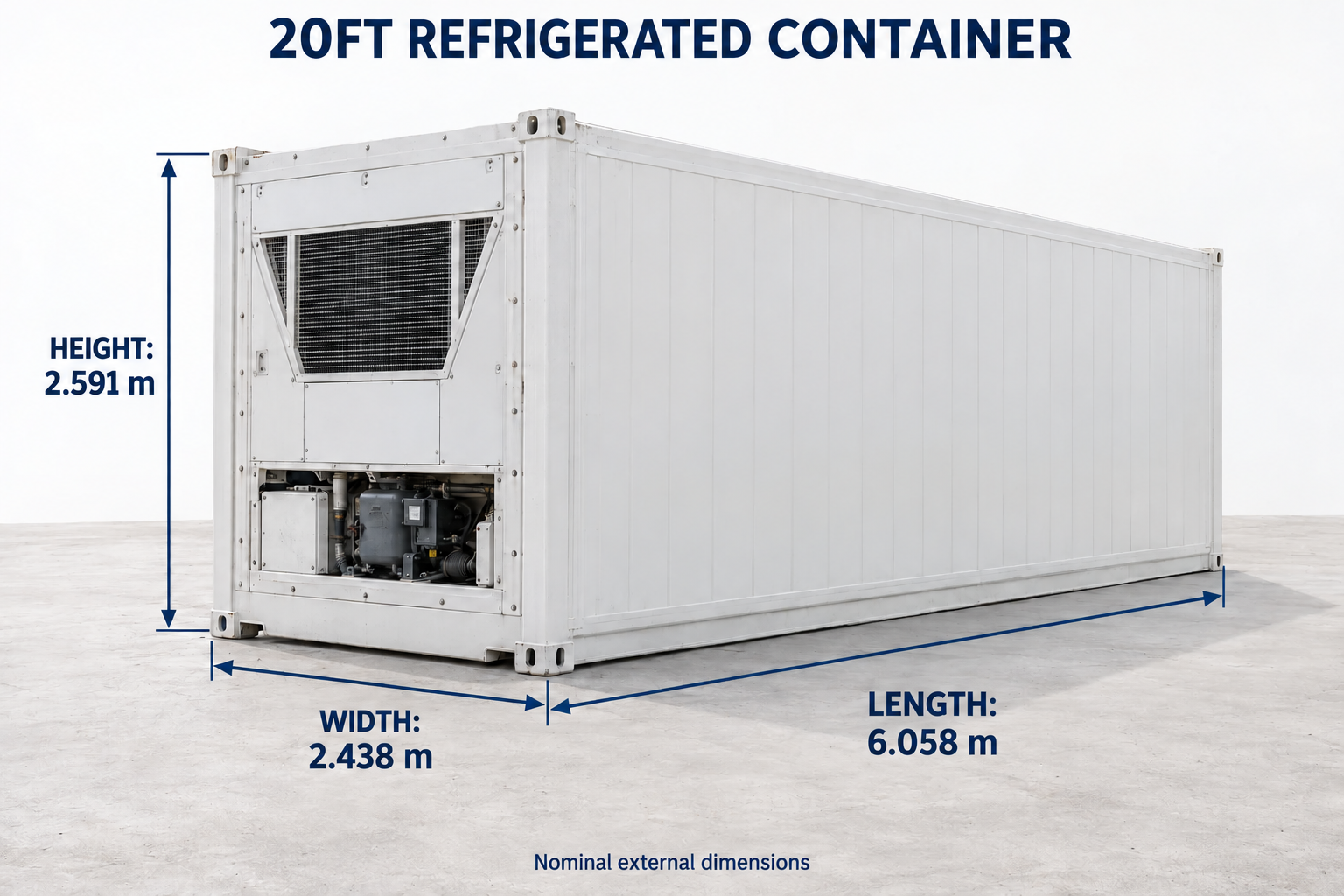
A 20ft refrigerated format for palletised batches or regularly accessed stock. Match the cargo-door or walk-in configuration to your load, power supply and delivery site.
Request a delivered quote
The supplier confirms the actual unit, working condition and delivery details.
“20ft” is a nominal format name. This documented cargo-door example lists a 6.058 m exterior length; its paired interior and doorway figures are shown below.
Swipe the table to see every column.
| Measurement | Length | Width | Height |
|---|---|---|---|
| Exterior, metric | 6.058 m | 2.438 m | 2.591 m |
| Interior, metric | 5.321 m | 2.235 m | 2.248 m |
| Cargo-door opening | — | 2.235 m | 2.248 m |
These dimensions are examples for particular models. Check the offered unit’s measurements, openings, ratings and usable clearances before planning storage, transport or installation.
Exterior, interior and cargo-door figures describe this one documented example. Door opening and interior height are separate measurements; confirm the actual unit, floor and load line.
Cargo doors and a T-floor suit a batch loading routine. Keep goods within the marked cargo-floor boundary and below the load line, following the actual unit’s airflow instructions.
Plan how each item can be reached. A single-door walk-in or portable layout can serve a different routine; compare its clearances and refrigeration separately.
Specify holding temperature, incoming product temperature, batch size and door frequency. A selectable range does not establish how quickly a warm load will cool.
Swipe the table to see every column.
| Operating requirement | What the supplier must confirm | Site confirmation |
|---|---|---|
| Holding temperature | Required setpoint, product temperature and dated test for the actual machine | Airflow, loading, insulation and door-opening routine |
| Cooling duty | Whether the unit can perform the required holding or pull-down duty | Incoming batch size and temperature; local ambient conditions |
| Electrical supply | Nameplate voltage, phase, 50 Hz compatibility, current and connector | Licensed electrician checks circuit, protection, earthing and any transformer |
Confirm the assigned unit’s nameplate voltage, phase, frequency, current and connector. Australian supply is nominally 230 V single phase or 400 V three phase at 50 Hz; a licensed electrician must confirm equipment compatibility, circuit protection and any transformer.
Choose a 20ft cargo-door reefer for a planned palletised batch; compare a walk-in layout when cartons must be reached repeatedly without moving the rest of the load.
The cargo-door example has a 5.321 × 2.235 × 2.248 m interior and a 2.235 × 2.248 m door opening. Portable and converted walk-in dimensions describe separate layouts.
A receiving batch and stock picked throughout the day need different access plans. The marine T-floor distributes air; a geometric aisle or a portable model’s pallet count does not validate its loading pattern.
Confirm the selected equipment is suitable for the Australian site supply: nominal 230 V single phase or 400 V three phase, 50 Hz. Have a licensed electrician check the nameplate, current, connection, protection and any transformer.
A new cooling motor does not make the shell new. Match the delivered access layout and refrigeration equipment to the documents before using the box for the intended load.
Compare Australian proposals for the same temperature duty, condition, refrigeration equipment and delivery postcode.
Request a current written offer for the assigned unit. Confirm the dispatch depot, availability, applicable GST, transport, unloading and site work. A missing charge is unresolved, not zero.
| Configuration to quote | Equipment evidence | Australian price confirmation |
|---|---|---|
| Used refrigerated container | Unit and machine identity; box condition; dated temperature test; warranty terms | Current total in AUD including applicable GST |
| Used box with replacement refrigeration | Identify the box and replacement machine separately; 50 Hz compatibility; guarantees | Confirm equipment, delivery, unloading and site electrical costs |
| New or one-trip reefer | Actual condition, machinery specification, temperature duty and electrical nameplate | Supplier confirms availability and complete written scope |
Request the machine identity, a dated operating test at the required temperature and checks of alarms, defrost and door seals.
Compare insulation, floor, repairs and equipment age separately. A new motor can be fitted to a used box; request the warranty terms for each.
Have the quote separate equipment, any transformer or conversion, transport, unloading, taxes and site electrical work.
Check the receiving route, doorway access, machinery clearance and delivery vehicle before choosing the 20ft footprint. Compare a compact or longer format when the load or approach changes.
Confirm the selected equipment is suitable for the Australian site supply: nominal 230 V single phase or 400 V three phase, 50 Hz. Have a licensed electrician check the nameplate, current, connection, protection and any transformer.
A used box with a new motor remains a used box. Inspect the insulation, seals, floor and repairs alongside the cooling system, and obtain the warranty terms for each.
Australian pallets commonly use a 1165 × 1165 mm footprint. Confirm your loaded pallet dimensions, actual container interior, door access and refrigeration airflow before agreeing a loading plan. No pallet capacity is guaranteed by nominal container length.
Request the offered machine’s identity, a dated refrigeration test, operation at the required temperature and checks of alarms and defrost. An insulated box with non-working refrigeration is a different purchase.
Compare the cooling needs and delivery work together.