
Build a full-term rental comparison
Use one column per written offer. Enter unknown when an amount or inclusion is unresolved; a blank is not a zero.
Planned rental expense = rent for the billable term + delivery and placement + collection + required extras + applicable taxes − confirmed credits. This is a cost worksheet, not a supplier tariff.
Keep a separately refundable deposit outside the expense total, but include it in the cash you need to pay upfront. Record its refund conditions. If a deposit is applied to rent, count that rental charge once rather than adding the deposit again. Any later deduction belongs in your final reconciliation.
| Cost or term | What to enter |
|---|---|
| Container and use | Size, door arrangement, condition, quantity and dry-storage or specialist use. Match these before comparing prices. |
| Rental charge | Rate per unit, billing-period length, minimum term and number of billable periods for your actual dates. |
| Delivery and placement | Transport to the address, unloading and positioning. Identify anything priced separately. |
| Collection | Return transport and loading, including whether the amount is fixed or will be quoted later. |
| Required extras | Any required protection charge, accessories or other recurring fee, with its billing basis. Count an included charge only once. |
| Taxes and credits | Quoted applicable taxes and confirmed discounts or credits, with the items to which they apply. |
| Conditional charges | The trigger and price for waiting, access failure, extra trips, cleaning, damage or a change of location. Keep untriggered charges separate. |
| Cash due and deposit | Payment dates and any deposit, including whether it is prepaid rent or a separate refundable security amount. |
Translate the advertised rate into your actual dates
Rental terms can use four-week cycles or calendar months. Those periods are not interchangeable. Ask for the billing start, the event that ends billing, the minimum term, and any rule for a partial final period.
If an agreement charges every started 28-day period in full, divide the chargeable days by 28 and round up, then apply any minimum term. Under that specific rule, 84 chargeable days use three periods; 85 use four. This calculation does not apply to a contract that prorates the final period.
For a calendar-month offer, request the actual billing schedule for your start and end dates. Do not turn a quoted monthly amount into a daily rate unless the agreement says to do so.
- Ask how much one additional day and one additional billing period would cost at your expected finish date.
- Record whether the rate can change at renewal.
- Resolve whether rent stops when you request collection, when the provider confirms termination, or when the container is collected.
A lower rental rate can produce a higher total
The following offers and every dollar amount are invented to demonstrate the calculation. They are not market prices, quotes or national averages.
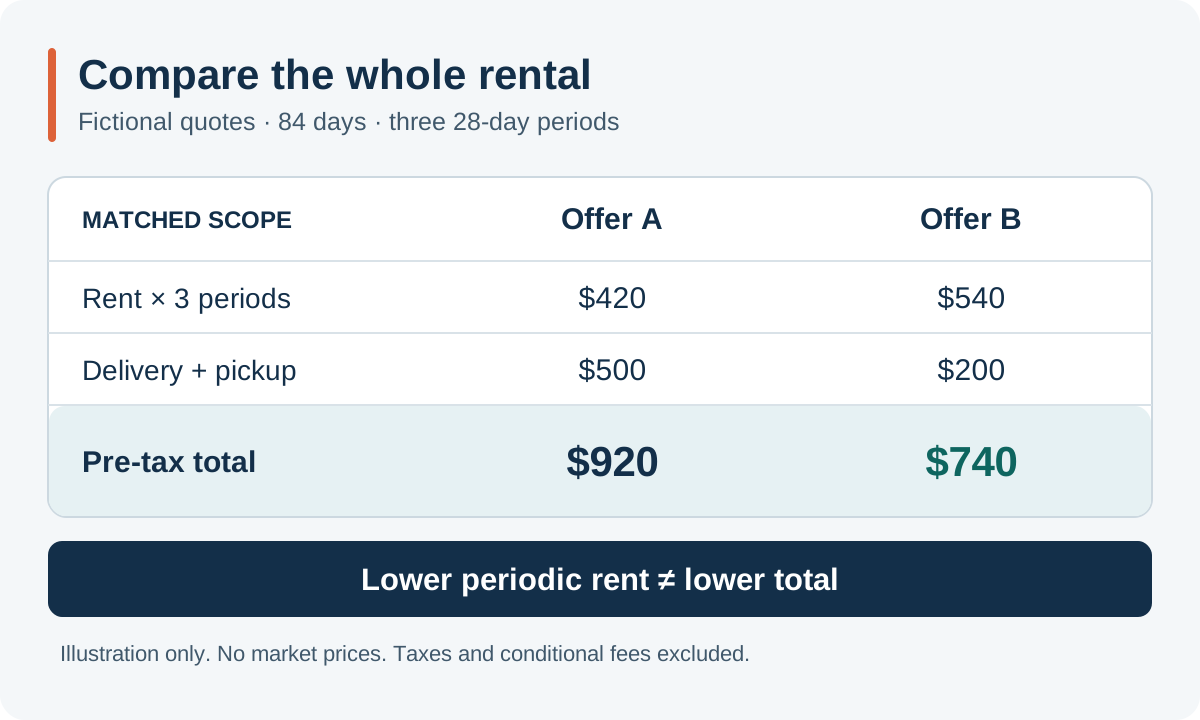
Assume one identical dry-storage container at the same address for exactly 84 chargeable days. Both fictional offers bill three full 28-day periods at a fixed rate and cover the same unloading and collection work. There are no other required extras in this example.
Offer B costs $180 less before tax, despite its higher periodic rent. Its two transport charges save $300, while its three rental charges add $120. For real offers, complete the tax and required-charge lines before treating a pre-tax subtotal as the final amount payable.
Duration can reverse the result. With the same fictional fixed charges and unchanged rates, eight periods would cost $1,620 for A and $1,640 for B before tax. Recalculate for your expected stay and a plausible extension; do not carry these invented rates into your own budget.
| Fictional comparison, USD | Offer A | Offer B |
|---|---|---|
| Rent per 28-day period | $140 | $180 |
| Billable periods | 3 | 3 |
| Rental subtotal | $420 | $540 |
| Delivery, including agreed placement | $250 | $100 |
| Collection | $250 | $100 |
| Illustrative pre-tax total | $920 | $740 |
| Taxes | Excluded from this example | Excluded from this example |
| Conditional charges and deposit | Not included in the comparison | Not included in the comparison |
Compare 20ft and 40ft rentals without mixing services
Request a separate full-term total for each size that could meet your storage need. Describe what must fit, how you will retrieve it and the available placement area. A rate for a 20ft container does not establish the rate for a 40ft container, and twice the nominal length does not establish twice the rent.
Keep ordinary dry storage separate from refrigerated storage, an office or a container-move service. The rental charge for keeping an empty unit at your site does not establish permission or a price for moving it with your goods inside. Specify the intended service before comparing offers.
- Use the same dates, address, quantity and required condition.
- Match the door arrangement and any accessories that you actually need.
- Ask whether delivery and later collection are feasible at the proposed position; account for any required work you arrange separately.
Plan collection before the last paid period
Get the required termination notice, contact method and collection procedure in writing. A pickup request is not proof that billing has stopped. Keep the confirmation and ask what happens if collection is delayed.
Confirm the return condition, emptying and cleaning requirements, lock removal and the access needed by the collection vehicle. Take dated condition photos when the unit arrives and when it is ready to leave. Record who will review a disputed cleaning or damage charge.
| Change to plan | Question to resolve before booking |
|---|---|
| Finish earlier | Does the minimum term still apply, and is any unused period refundable? |
| Stay longer | What is the renewal rate, and can one extra day trigger a whole new period? |
| Move the unit | Is relocation permitted, who can perform it, and what transport charge applies? |
| Collection cannot proceed | What happens to rent and any failed-visit charge if the unit is not empty or accessible? |
If the end date is uncertain, compare buying over the same horizon
Compare the full rental total at your likely finish date and at a longer fallback date with the complete purchase budget over those same dates. For ownership, include delivery, required work, maintenance and eventual removal or sale costs where relevant.
An expected resale amount is an assumption until there is a real buyer and an agreed price. Keep a no-resale scenario alongside it. Do not infer a universal rent-versus-buy deadline from a monthly rental rate or assume ordinary rental payments build ownership.
Send a rental-specific brief to the provider you choose
Give the provider your delivery address, intended use, preferred size and quantity, requested start date, earliest and latest finish dates, placement details and access information. Ask it to complete the comparison sheet for that exact scope.
Request a written total for the planned stay and an extension scenario, with collection, renewal, taxes, deposit and conditional fees identified. ContainerPick supplies this planning worksheet; it does not book a rental or obtain rental offers for you.
Buying questions
How much does it cost to rent a shipping container per month?
Obtain a rate for your size, use, address and dates, then check what month means in that offer. Add delivery, collection and required charges for the full stay. The numbers in this guide are fictional calculation examples, not observed rental rates.
Is a 28-day rental period the same as a calendar month?
No. Use the billing schedule and partial-period rules in the agreement. For example, three 28-day periods cover 84 days; do not assume they cover the same dates as three calendar months.
Does container rent include delivery and pickup?
Only if the written offer includes both for your address and agreed handling scope. Ask for each transport leg to be identified, even when it is included in a package price.
Should I add a refundable deposit to the rental cost?
Track a separately refundable deposit as upfront cash, rather than counting it as a final expense. Check the refund conditions and whether it is actually prepaid rent; record any amount eventually retained or applied without counting it twice.