
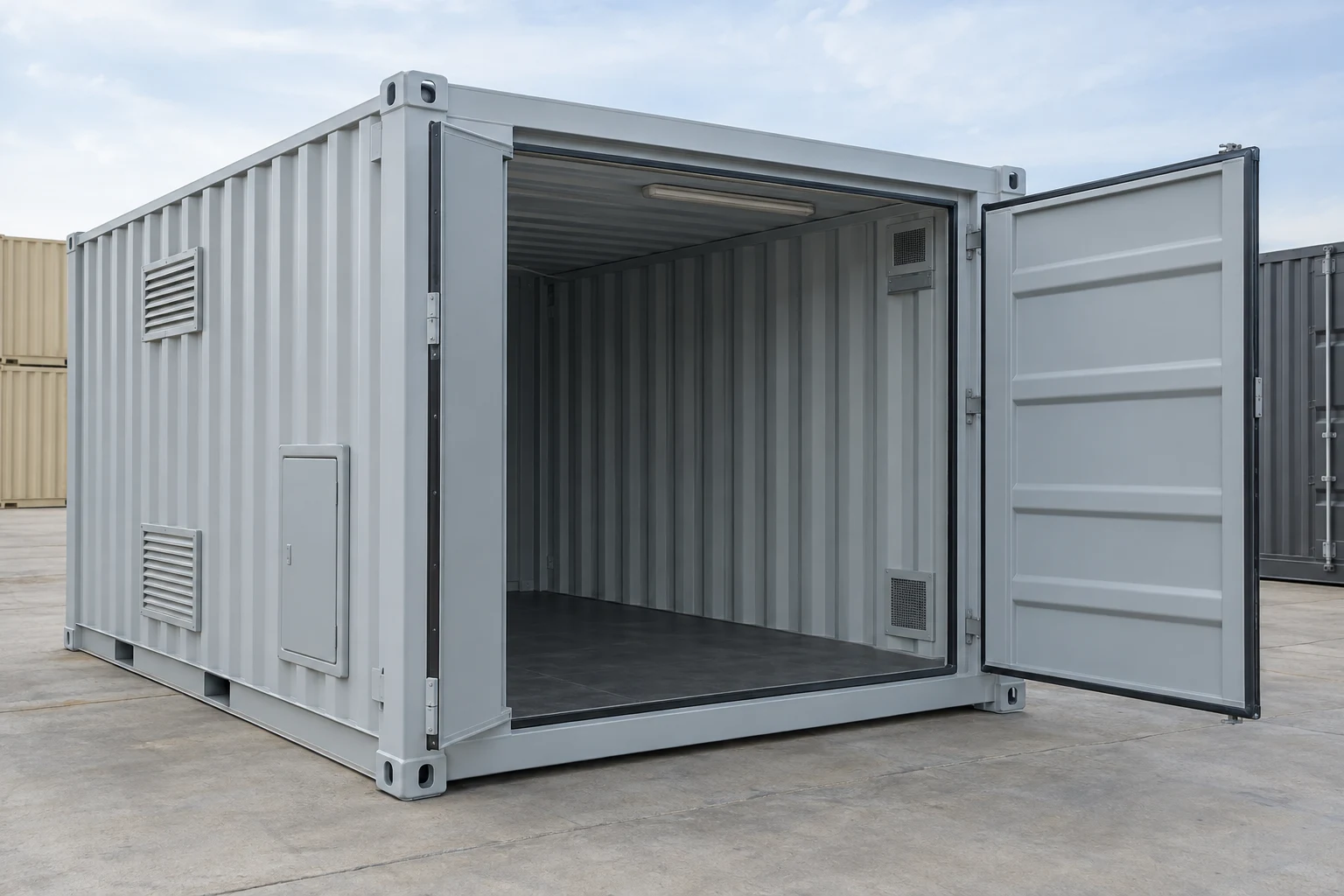
Choose the enclosure scope before comparing prices
An equipment housing quote can cover a steel shell, a modified container or a package with specified systems installed. Compare these at the same level of completion. A housing price does not establish that machinery, controls or commissioning are included.
| Option | Scope to compare | Key buying question |
|---|---|---|
| Modified shipping container | Existing shell adapted with specified access and interfaces | Does the finished layout accommodate the equipment, support loads and service work? |
| Purpose-built enclosure | Housing fabricated around a defined equipment arrangement | Which dimensions, access features and handling details are documented? |
| Equipped package | Housing plus identified mechanical, electrical or control work | Which equipment and systems are supplied, connected and tested, and what remains on site? |
Allow room to install and maintain the equipment
Compare usable interior space with the manufacturer's equipment layout and service clearances. Door positions, removable panels and any removable roof arrangement should support the work you expect to perform. Include a route for bringing in the equipment and removing the largest service component.
Provide equipment weight and the locations where it bears on the enclosure. Total weight alone does not describe concentrated loads or mounting needs. The quote should address the equipment supports, handling arrangement and finished unit weight for the proposed configuration.
Match heat, airflow and noise to the operating duty
Use the equipment's expected heat output, operating schedule, acceptable temperatures and site conditions to compare thermal-control options. Passive ventilation, forced airflow and a cooled interior describe different packages; their suitability depends on the equipment and operating conditions.
Separate ventilation equipment from openings provided for a later installation. Identify louvers, filters, fans and any required exhaust connections in the scope. Where the equipment needs dedicated exhaust or process controls, define those separately from comfort cooling. A noise-reduction claim also needs a stated target, operating condition and measurement basis.
Define where the enclosure ends and the site begins
For electrical work, identify the supply requirements, installed components and connection points. Mechanical services need the same clarity: which pipes, fittings or penetrations are included, and where the site's services connect. Equipment controls and communications may need their own interfaces.
Factory-installed systems and an operating installation are different scopes. Compare who supplies the equipment, completes connections, carries out startup and verifies the agreed result. Include the site's power and other services in that division of responsibility.
| Interface | Define in the project scope |
|---|---|
| Equipment to enclosure | Mounting locations, support details, access and service clearances |
| Services to equipment | Supply requirements, connection locations and installed components |
| Enclosure to site | Placement, supports or foundations, anchoring and site connections |
| Finished unit to transport | Weight, lifting/handling details, route and required transport documentation |
Prepare a quote tied to the equipment
Start with the equipment drawings or data sheet, weight and support points, maintenance clearances and operating requirements. Add the intended enclosure layout, destination ZIP code and any limits on delivery or placement. These inputs make housing options comparable without guessing from the outside dimensions.
A useful proposal links its price to a layout and stated supply scope, with delivery, unloading, site work and commissioning clearly allocated. For thermal or acoustic performance, identify the documented target and how it will be checked. Design services, calculations and project approvals should be identified explicitly rather than assumed from a container sale.
Buying questions
Does a modified container retain its shipping certification?
Do not assume the starting container's status applies to the finished enclosure. If the unit must travel intermodally, ask for the documentation for that completed configuration and the intended transport route.