
Choose accessories by the problem they solve
| Need | Family to compare | Important check |
|---|---|---|
| Control door access | Padlocks, lock boxes and door-bar locks. | Existing hardware, complete system and key access. |
| Reach stored goods | Shelving, racks and storage bins. | Mounting method, clear aisle and the system’s stated load limits. |
| Cross the door threshold | A suitable ramp or access system. | Threshold height, approach, surface, intended equipment and rated load. |
| Improve visibility | Lighting suited to the use and environment. | Supply, mounting and installation requirements. |
| Address moisture | Ventilation or other moisture-management measures. | The cause, local conditions and sensitivity of the stored goods. |
| Replace a damaged component | Door hardware, seals, vents or other matching parts. | The actual part, dimensions and scope of the repair. |
Identify replacement parts before ordering
Container door hardware can include bars, handles, hinges and seals. Similar-looking parts are not necessarily interchangeable. A useful request shows the whole door, the component in place and close views of its fixing points.
Record measurements using the supplier’s instructions. Include any part identification you can read, the position on the container and whether previous repairs have changed the fitting. A generic photograph of a 20ft container does not identify a replacement seal or hinge.
A worn part and structural damage are different jobs. If damage affects the frame, roof, floor or a load-bearing connection, have the repair assessed for the intended use. A patch or replacement component alone does not establish the finished container’s condition.
Plan shelving, ramps and lighting together
An accessory can reduce usable width or height, obstruct a door or compete for the same mounting points as another system. Plan the completed arrangement before ordering the separate pieces. Ratings belong to the particular product and installation; do not use a container’s cargo payload as a shelf or ramp rating.
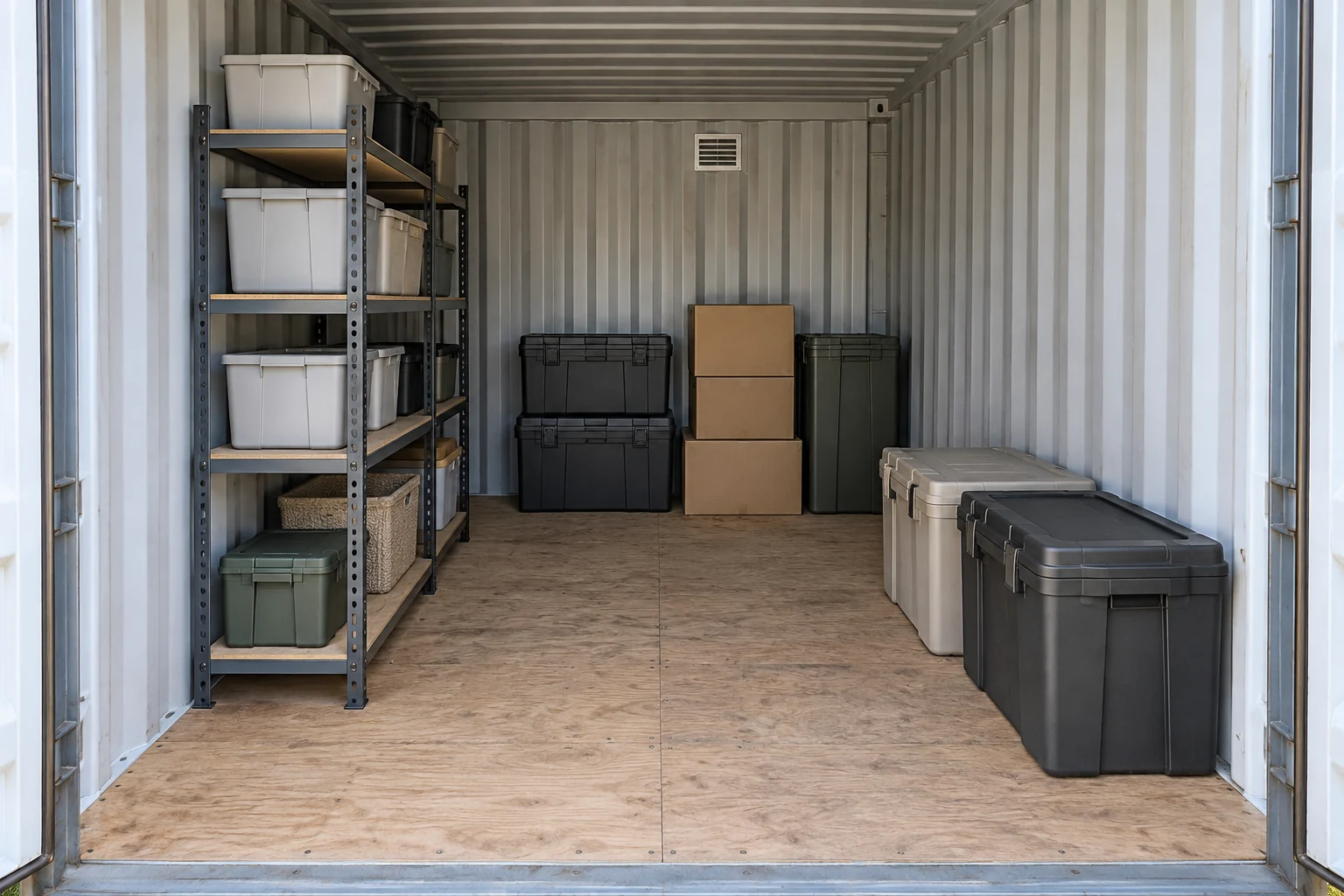
- Shelving: confirm how it attaches, what the supplied system includes and its stated load limits. Allow for the actual bins and a clear route through the unit.
- Ramps: match the door threshold and the equipment you intend to move. Check the ramp’s rating, support and approach instead of selecting by width alone.
- Lighting: define when you need it and how it will be supplied. Follow the equipment’s mounting and electrical installation requirements.
- Security: identify the door hardware before adding a lock or protective cover. Use the lock guide for the compatibility checklist.
Ventilation is one part of moisture management
First distinguish a leak from condensation. Damp goods, packaging and changes in temperature can contribute to moisture inside a closed container. Adding a vent does not prove the cause has been resolved.
The appropriate approach depends on the goods, climate and use. Confirm the vent’s fitting and instructions, and compare insulation or other measures where appropriate. Use the insulation guide for the broader design questions; a basic storage container is not automatically a controlled indoor environment.
Check fit, mounting and kit contents
A shipping container modification kit can be a framing kit, a set of brackets or a larger package. The word kit does not establish that a door, glazing, insulation, tools or installation is included. Compare the itemized contents before treating two offers as equivalent.
| Before ordering | Ask the supplier to confirm |
|---|---|
| Unit and location | The container type, component position and relevant photographs or measurements. |
| Mounting | Whether the system clips on, bolts on, uses existing fittings or requires welding or cutting. |
| Included components | The full bill of materials, including fasteners, locks, brackets and finishing pieces. |
| Work still required | Tools, fabrication, sealing, coating, electrical work or other installation steps. |
| Operating space | Door movement, aisle width, key access and the space lost to the fitted accessory. |
| Limits and instructions | The applicable rating, installation conditions and maintenance documents. |
When an accessory becomes a modification
New openings, roll-up doors, windows and changes to the structure need a plan for the finished unit. Compare a supplied modified container with a kit that still requires fabrication and installation. The modified-container pages cover those project choices.
Connectors and lifting equipment also need their own technical specification and intended-use assessment. Treat them separately from ordinary shelving and storage accessories.
For a replacement part, prepare the component information for its supplier. If your need is a complete container or a finished conversion, use the container and modification options below, then record the requirements in a unit request.
Buying questions
Can container shelving be installed without welding?
Some systems use existing attachment points or a clip-on or bolt-on arrangement. Others require different preparation. Confirm the exact mounting method, the container fitting and the product’s load limits.
Do container vents prevent all condensation?
No single vent guarantees that. Identify whether moisture is entering through a leak or forming inside, then consider the goods, climate and full moisture-management approach.
Are all shipping container parts standard?
Do not assume interchangeability from the container length or a similar appearance. Confirm the component, measurements, fixing points and any changes made by previous repairs.
What is included in a modification kit?
The supplier’s bill of materials defines the contents. A framing kit may omit the door or window itself, as well as tools, sealing and installation. Establish those items before comparing the total job.
Can an accessory change the space available inside?
Yes. Shelving, lining, fittings and their clearances can reduce usable space. Plan the completed layout and door operation before ordering.