
40FT / STANDARD HEIGHT
New / one-trip
A less weathered finish
Compare handling marks, included fittings and the work a used shell would need.
Explore New / one-trip →Compare offers from multiple suppliers. Find the right price for your project.
40FT STANDARD HEIGHT / AS-IS
Evaluate a standard-height 40ft as-is container as a unit with defects and repair responsibilities to establish before purchase. The label alone does not promise a leak-free roof, working doors, a serviceable floor or cargo-transport suitability. Compare the identified work and handling costs with a WWT alternative before choosing a lower-priced shell.
Standard height: 40ft × 8ft × 8ft 6in exterior. Compare 40ft High Cube →
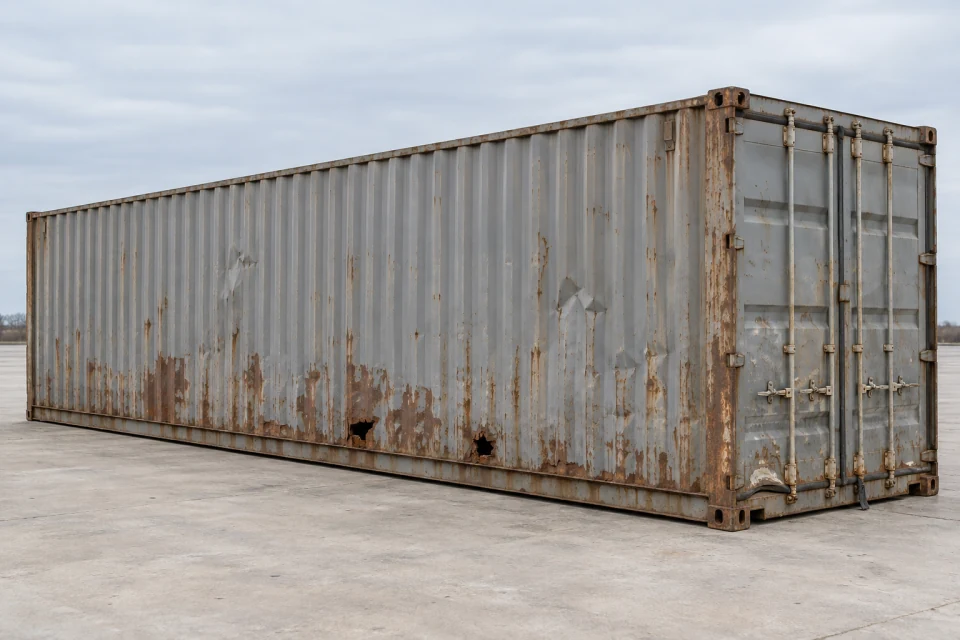
Ask for the container number and current photos of the offered unit, rather than a representative picture. Record the damage and the seller’s explicit assurances or exclusions before arranging purchase and transport.
| Area | What to identify |
|---|---|
| Roof and walls | Holes, deeply corroded areas, damaged seams, dents that retain water and previous patches. |
| Doors | Whether both leaves open, close and lock; damaged hinges, bars, seals and alignment. |
| Floor and supports | Broken or soft panels, contamination concerns, damaged supporting structure and earlier repairs. |
| Structure and handling | Damage to corner fittings, rails or posts that needs qualified assessment before lifting or moving. |
Obtain a repair scope for the actual defects. Steel replacement, floor work, door repairs, cleaning and repainting are different tasks; a paint quote does not establish that holes or structural damage will be repaired.
Agree where the work will happen and how the repaired condition will be checked. If the offered unit cannot meet the use you require at an acceptable total cost, compare a different unit or grade.
Use actual itemized quotes and the same intended result. An unknown repair cost is not zero, and a lower purchase price does not establish the cheaper usable-storage option.
| Include in both totals | As-is offer | WWT alternative |
|---|---|---|
| Unit and transport | Purchase price plus movement to the repair location and final site if separate. | Purchase price plus delivery to the same final site. |
| Unloading and handling | Any special equipment or extra handling caused by the unit’s condition. | The confirmed unloading and placement arrangement. |
| Required work | Assessed repairs, cleaning, materials, labor and checks after completion. | Any work still needed for your storage layout or equipment. |
| Unresolved cost | Keep unassessed defects and unquoted work visible as unknown. | Keep unquoted delivery, installation, taxes and fees visible as unknown. |
Share the defect list and photos with the transporter and whoever will unload it. Establish the handling method for that actual unit, including any structural assessment or repairs needed before movement.
A 40ft footprint does not describe the delivery truck’s working envelope. Review the approach, turns, overhead obstacles, ground condition, support and final door orientation with the operator.
Put the unit identity, known defects, promised work, acceptance criteria and responsibility for repairs in writing. Read any condition assurances, exclusions and return terms; the as-is label is not a substitute for the actual agreement.
Do not treat “last trip” as an automatic equivalent of as-is or assume a repaired unit is cargo worthy. Weather sealing, storage usability and transport suitability each need evidence for the intended use.
No. Ask what is assured for the actual unit. Some units may have sealing, floor, door or structural defects; the as-is label alone does not resolve them.
Compare the same usable outcome, including repairs, cleaning, additional moves, handling and taxes. Keep unassessed work visible as an unknown cost.
Repainting changes appearance. Cargo-transport suitability, inspection and required documents need separate assessment; a painted surface does not establish them.
Keep the format, condition, intended use and delivery requirements together when comparing supplier offers.
Prepare my As-is request →Choose the condition your project needs. The supplier confirms the actual unit, condition criteria and availability.
A less weathered finish
Compare handling marks, included fittings and the work a used shell would need.
Explore New / one-trip →For enclosed on-site storage
Establish sealing, floor and door condition. Plan moisture-sensitive storage separately.
Explore Wind & water tight →For a cargo-transport project
Establish the unit inspection, current examination and documents required for the shipment.
Explore Cargo worthy →For an assessed repair project
Compare disclosed defects, handling and repair costs with a WWT alternative.
You are viewing this conditionUsed appearances can overlap across grades. An illustration cannot establish watertightness, cargo suitability or the defects of an offered unit.